
Air Fryer Accessories for Different Cooking Needs
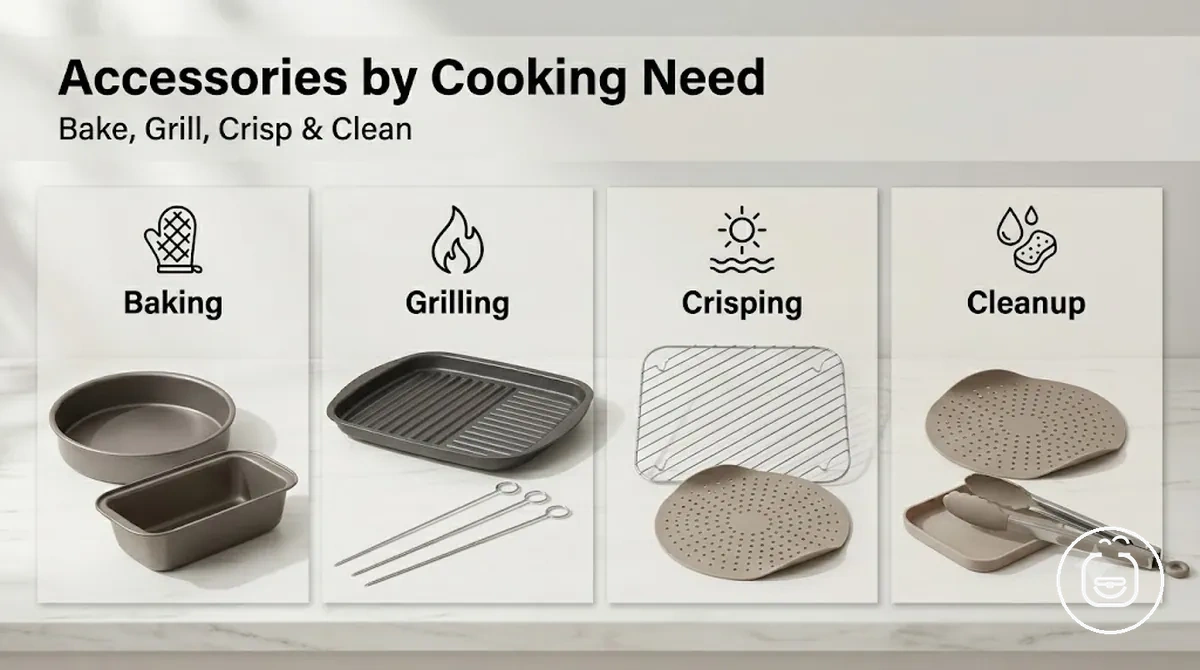
Air fryer accessories should be chosen by cooking needs before accessory name or product example. This page is a guide to matching air fryer accessories with baking, grilling, crisping, cleanup, and oil-control needs. The useful choice is the tool that supports the food shape, basket fit, airflow path, and cleanup burden for that cooking situation. A baking pan, rack, liner, or oil sprayer should serve the need instead of becoming the main reason to collect more add-ons.
Baking often needs a contained surface, so a baking pan may help when batter, dough, or sauce needs depth and clearance. Grilling and crisping often need more exposed surface, so a rack or raised insert may support airflow when the basket has enough space. Cleanup needs often point toward a liner or silicone mat, but coverage can affect airflow if it blocks too much of the basket. Oil control is different again because an oil sprayer is mainly about surface coverage, browning support, and control rather than adding another cooking surface. The selection logic is need first, then accessory function, then fit, airflow, and material condition.
Accessory choice depends on food type, fit, airflow, and cleanup burden. Not every reader needs every accessory. The better match is the cooking accessory that solves the current cooking problem without crowding the basket or promising an outcome that depends on the air fryer model.
How Cooking Needs Determine the Right Air Fryer Accessory
A cooking need determines accessory shape, accessory function, and cleanup role. Different cooking goals require different combinations of airflow exposure, material, and basket fit. The right choice depends on how the accessory supports the intended outcome rather than on the accessory name alone.
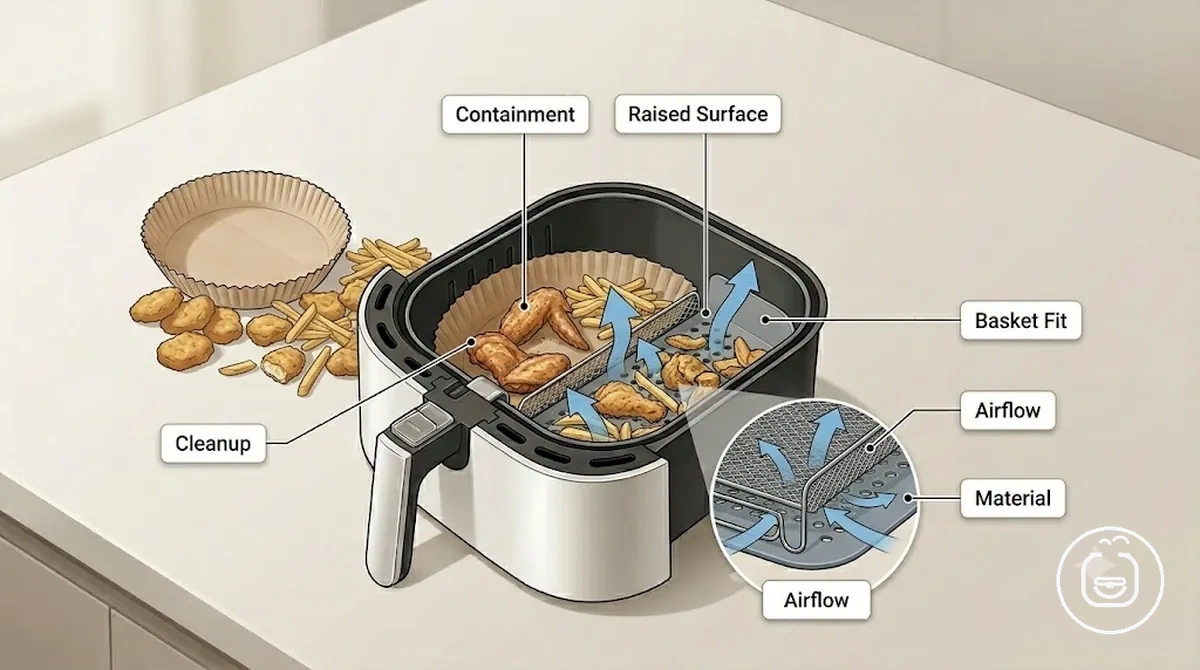
When the cooking goal is containment, a pan-style insert may matter more than elevation. When the goal is lifting or surface exposure, a raised surface may support airflow if the basket provides enough clearance and fit. When the goal is mess control, a liner can help reduce cleanup burden, although coverage may affect airflow exposure in some situations. This page selects by cooking need, while the broader air fryer accessories guide provides supporting context on accessory types and usage.
Choosing by accessory name alone can lead to a weaker match because the same accessory label may perform differently depending on accessory shape, material, airflow exposure, and basket conditions. Matching the cooking goal to the accessory function creates a clearer selection process. The table summarizes the relationship between cooking need, key attribute, and selection caution.
| Cooking need | Accessory function | Key attribute | Selection caution |
|---|---|---|---|
| Contained foods | Holds food with limited spread or movement | Accessory shape, depth, and heat-safe material | Fit depends on basket clearance and available space |
| Exposed foods | Creates more surface exposure around the food | Raised surface, spacing, and shape | Airflow may be reduced when the basket is crowded |
| Crisping | Supports airflow around more food surfaces | Elevation, spacing, and airflow exposure | Results can vary by food type, quantity, and fit |
| Cleanup | Helps manage residue and mess control | Material, coverage, and liner design | Excess coverage may limit airflow in some conditions |
Accessories for Baking, Pizza, and Contained Foods
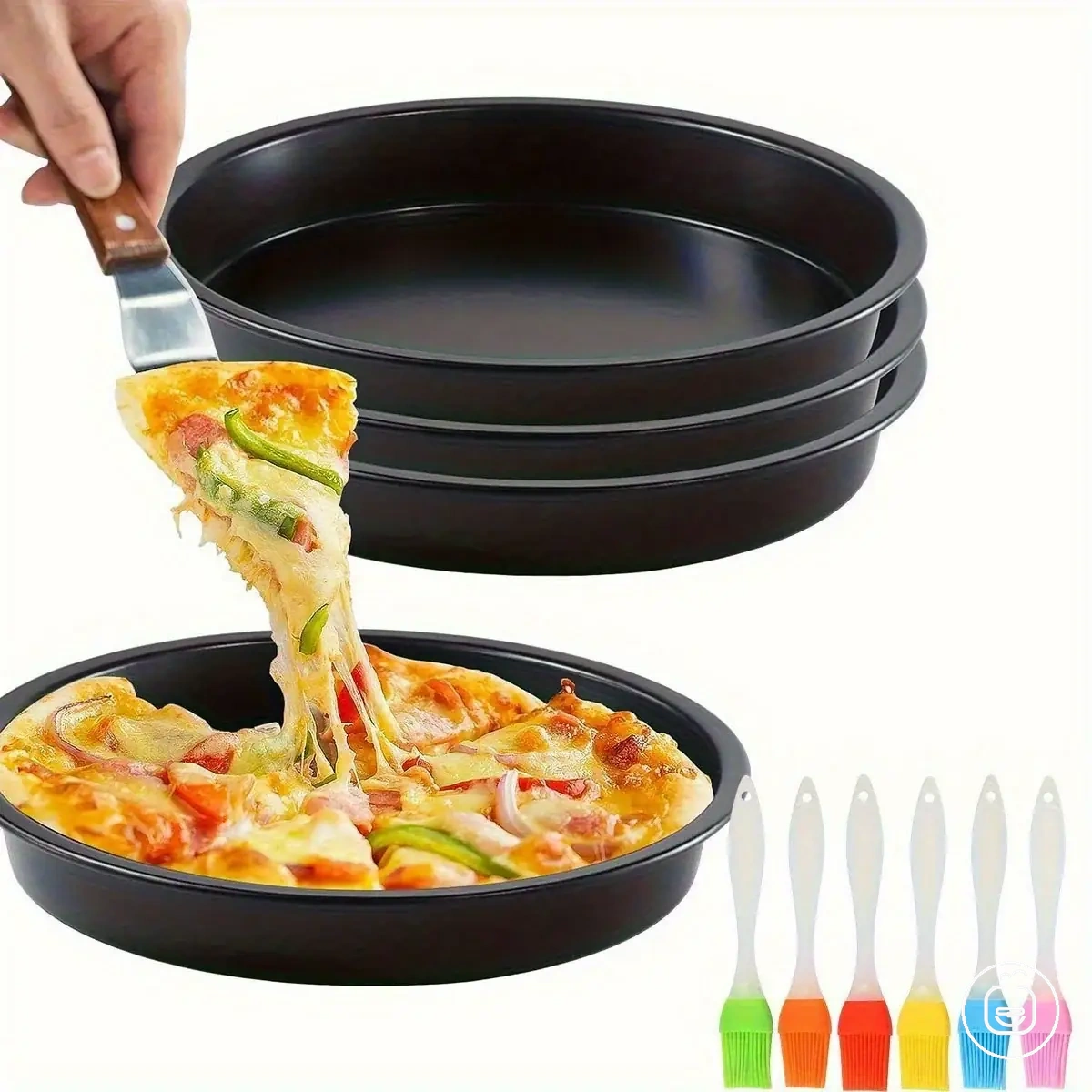
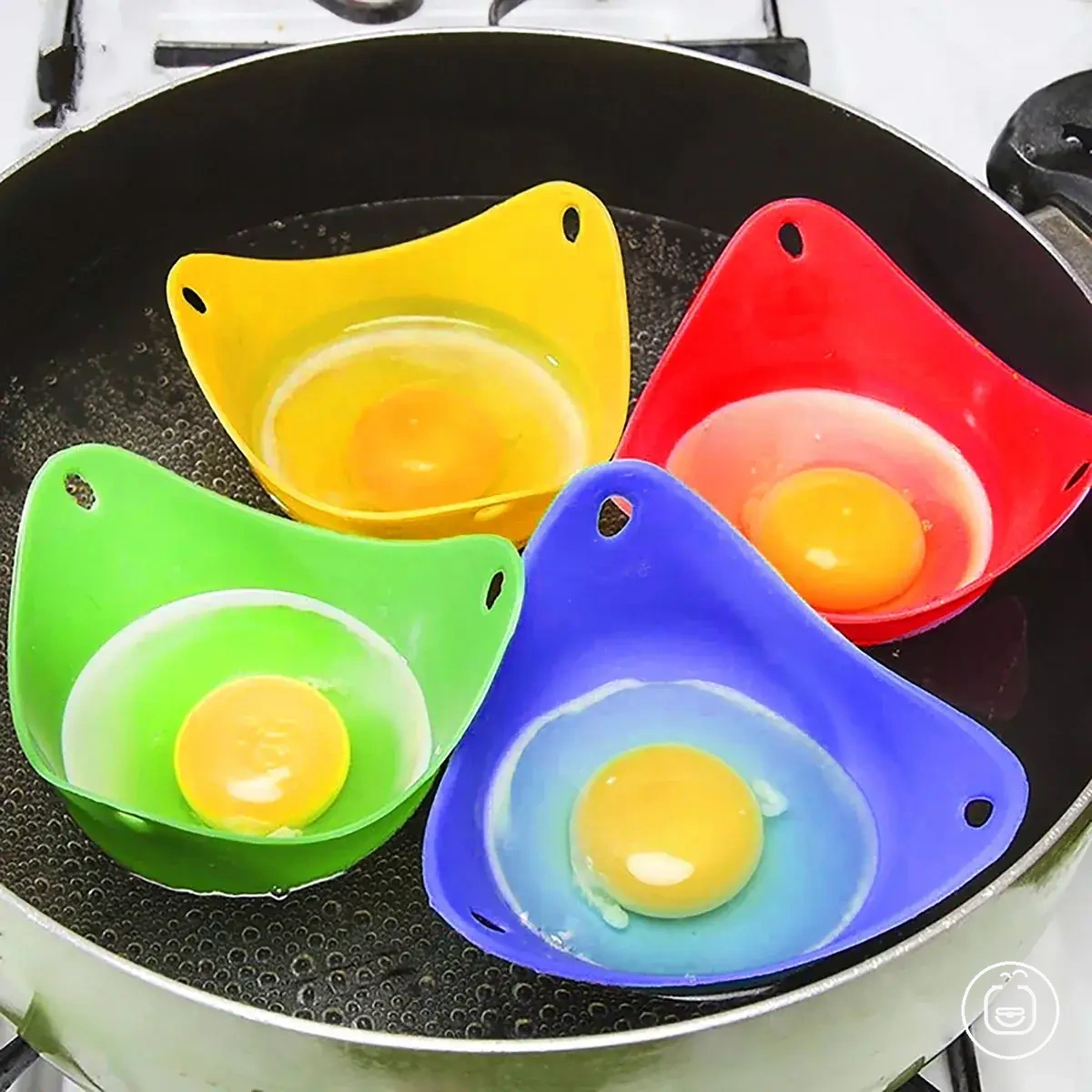
When food needs containment, accessories with walls, depth, or molded sections become more useful than open cooking surfaces. Contained foods such as batter, dough, sauce, eggs, and small portions benefit from a baking pan, pizza pan, cake pan, or egg mold because these accessories help maintain shape during cooking. A baking pan or mold can support ingredients that may spread on an open rack. For this reason, open racks are not always suitable for contained foods.
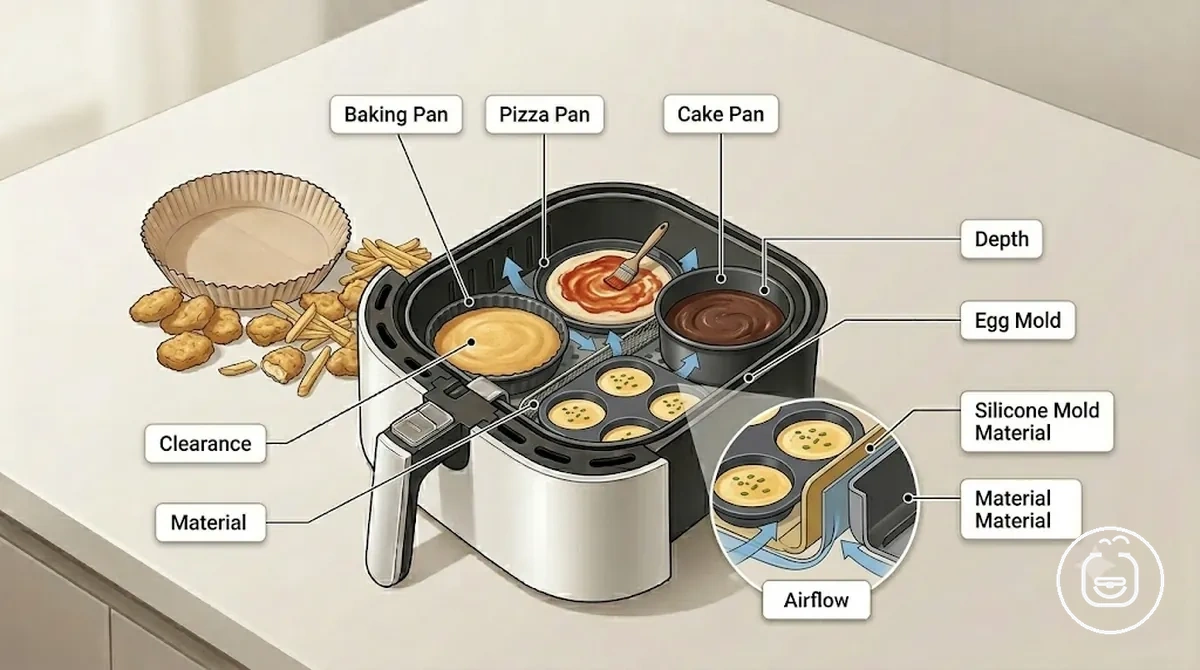
Accessories for Baking, Pizza, and Contained Foods are selected by depth, diameter, heat-safe material, and clearance. A shallow pizza pan may suit dough that benefits from a wider cooking surface, while a deeper cake pan or egg mold may provide better containment for batter, sauce, or portioned foods. Even when a pan uses a heat-safe material, fit can still depend on basket dimensions and available clearance. The table below compares common contained-food needs and the accessory attributes worth checking.
| Food need | Accessory type | Attribute to check | Selection note |
|---|---|---|---|
| Batter-based foods | Baking pan | Depth and heat-safe material | Check clearance so the pan fits without crowding the basket |
| Pizza-style dough | Pizza pan | Diameter and shallow profile | Diameter should suit the available basket space |
| Cake-like foods | Cake pan | Depth, shape, and material | Deeper molds may need additional clearance |
| Egg portions | Egg mold | Portion shape and stability | Stable molds can help with handling and removal |
A baking pan, pizza pan, cake pan, or egg mold is suitable when food requires containment rather than an exposed cooking surface. The choice depends on depth, diameter, clearance, and material rather than accessory name alone. Matching the accessory to the food condition can support containment, surface browning characteristics, and portion stability.
Baking Pans, Pizza Pans, Cake Pans, and Egg Molds
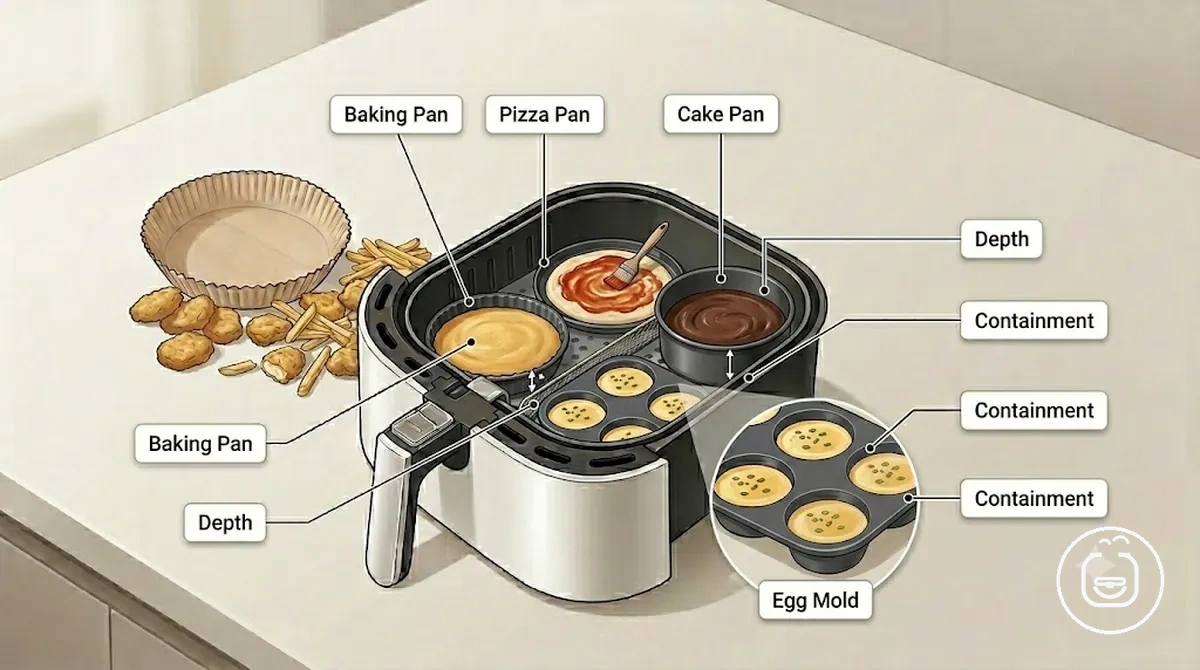
Baking pan, pizza pan, cake pan, and egg mold accessories differ mainly by shape, depth, and containment role. A baking pan and pizza pan use shallower forms, while a cake pan or deeper mold provides greater depth for foods that need more structure support. This distinction between shallow and deep forms helps organize accessory selection by shape and depth.
| Accessory | Main attribute | Best-fit food condition | Selection caution |
|---|---|---|---|
| Baking pan | Moderate depth and containment | Batter needing shape stability | Fit may depend on basket clearance |
| Pizza pan | Shallow surface and wider diameter | Dough that may benefit from broader surface exposure for browning | Diameter should suit available basket space |
| Cake pan | Greater depth and containment | Foods needing more height and structure support | Additional depth may require more clearance |
| Egg mold | Portion shaping and separation | Small portions requiring stability | Removal may vary by mold material and food condition |
When selecting among these accessories, a baking pan is often suited to batter, a pizza pan to dough, a cake pan to deeper containment, and an egg mold to portion shaping. For a broader clarification of named accessory roles, see accessory types explained. Stability and removal can depend on shape, depth, and food condition, which is why different accessory forms serve different roles.
When Regular Oven-Safe Bakeware Fits the Need
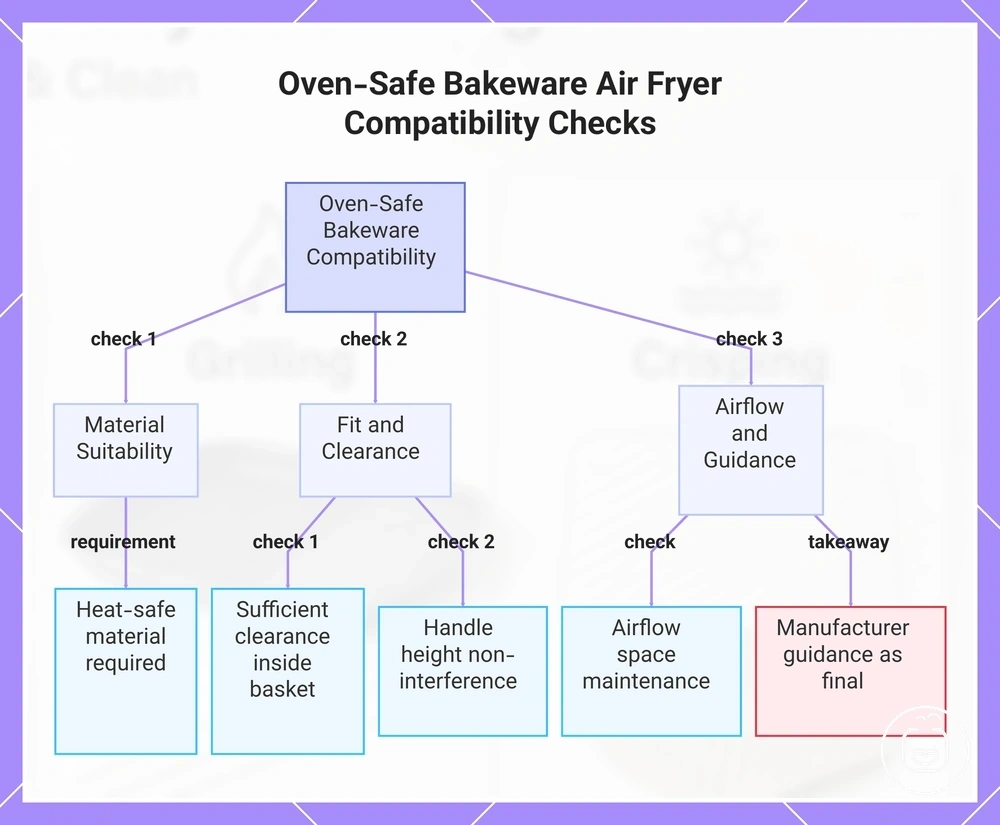
Oven-safe bakeware may work in an air fryer basket only when a heat-safe material, proper fit, adequate clearance, and sufficient airflow space are all present. Compatibility depends on both the bakeware and the air fryer basket conditions. A bakeware insert that meets these conditions may be suitable, while a poor fit can create clearance or circulation concerns.
Before using an ovenproof dish, pan, or mold, check the conditions that influence suitability. Limited clearance, excessive handle height, or reduced airflow space can increase the risk of blocked circulation and affect the compatibility decision. The checklist below provides a simple screening process. Manufacturer guidance should remain the final reference when suitability is uncertain.
- Confirm the bakeware uses a heat-safe material intended for oven use.
- Check that the bakeware leaves enough clearance inside the air fryer basket.
- Verify that handle height does not interfere with available basket space.
- Maintain airflow space around the bakeware to reduce the risk of blocked circulation.
- Review manufacturer guidance because fit and suitability may vary by air fryer design.
This chart shows the main conditions to verify when using regular oven-safe bakeware in an air fryer, including material, fit, and airflow checks.
Accessories for Grilling, Skewering, and Roasting
Exposed-surface foods often need accessories that lift, hold, or separate food to increase heat exposure across more of the surface. Grilling commonly relies on a grill tray or grill pan for flatter surface contact, while skewering uses a skewer rack to keep pieces separated with consistent spacing. Roasting may benefit from a raised surface or roasting rack when food needs elevation rather than direct basket placement. Lifting or holding food is important because browning, turning access, and portion capacity can depend on food shape, basket clearance, and load.
| Cooking need | Accessory shape | Food shape | Stability consideration |
|---|---|---|---|
| Grilling | Grill tray or grill pan | Flat or broad pieces needing surface contact | Fit, material, and basket clearance may affect browning and stability |
| Skewering | Skewer rack with separated skewers | Small pieces that benefit from spacing and turning | Load stability can depend on spacing, food weight, and rack support |
| Roasting | Raised surface or roasting rack | Larger foods needing elevated exposure | Height, load, and basket clearance may influence support and safety |
The choice between grilling, skewering, and roasting depends on how food needs to be exposed and supported. A grill tray provides flat contact for grilling, a skewer rack separates pieces for spacing and easier turning, and a raised surface supports roasting by elevating food above the basket. Each accessory addresses a different balance of exposure, spacing, height, material, and load stability.
Choose based on food shape and support needs. Flat foods often suit a grill tray, while separated pieces may work better on a skewer rack and larger items may benefit from a raised surface. Browning, fit, airflow, and portion capacity can vary with basket clearance, accessory dimensions, and load stability.
Grill Trays, Skewer Racks, and Raised Cooking Surfaces
Grill trays, skewer racks, and raised cooking surfaces differ by how they support food through surface contact, spacing, and height. A grill tray keeps food flat against a contact surface, a skewer rack separates food along skewers with controlled spacing, and a raised cooking surface elevates food above the basket floor. Surface contact and vertical clearance are the key attributes that affect accessory choice within this support category.
| Accessory | Contact Pattern | Key Attributes | Selection Caution |
|---|---|---|---|
| Grill tray | Broad surface contact | Contact surface, low height, stability | Browning may vary with material, fit, and basket clearance |
| Skewer rack | Separated support points | Spacing, turning ease, stability | Load stability may depend on food weight and spacing between skewers |
| Raised cooking surface | Elevated support | Height, exposure, stability | Added height can reduce available clearance when basket space is limited |
When smaller pieces need more turning ease, a skewer rack can create separation through spacing. When capacity depends on vertical organization, a raised cooking surface may provide additional usable levels if height and basket clearance remain suitable. Stability and capacity can vary with load size and arrangement, so clearance should be checked before adding elevated support.
Accessories for Crisping and Air Circulation
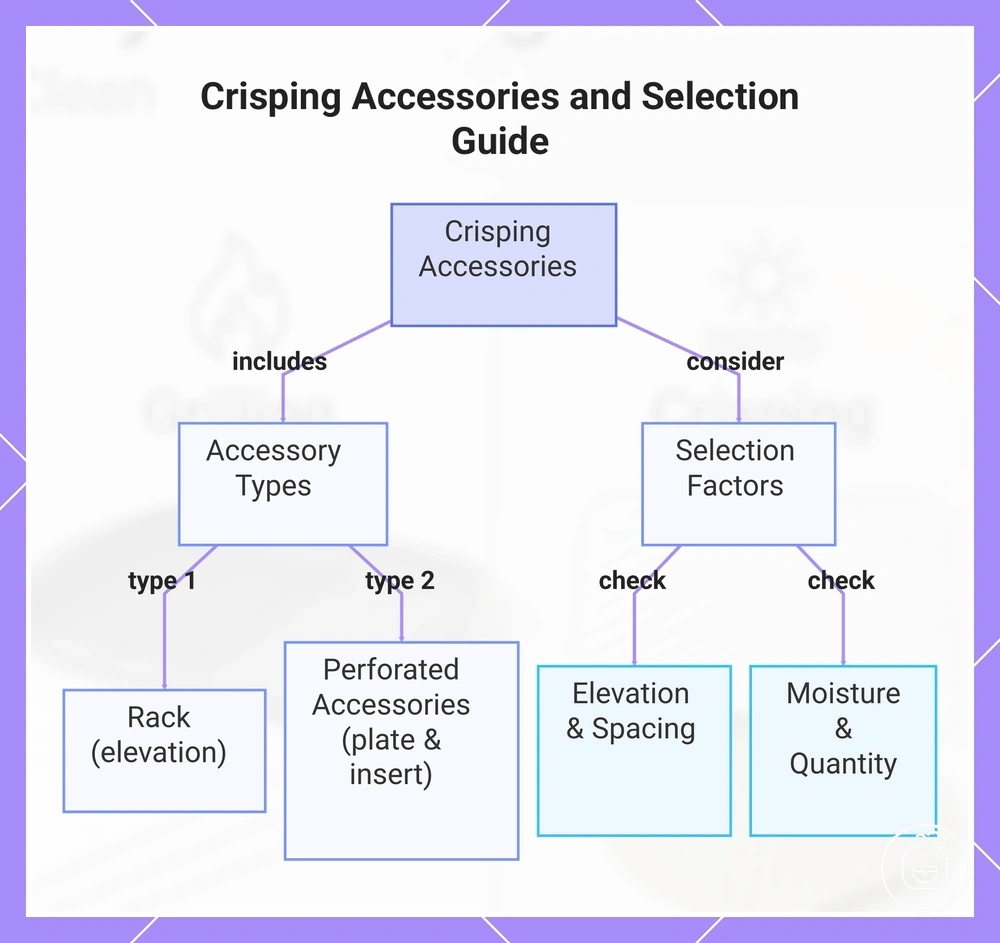
Crisping support depends on airflow, spacing, and exposed food surface. Accessories that raise food or preserve air circulation can increase exposure around the basket. Crispness, browning, and sogginess risk still depend on food moisture, quantity, preheating, and accessory fit.
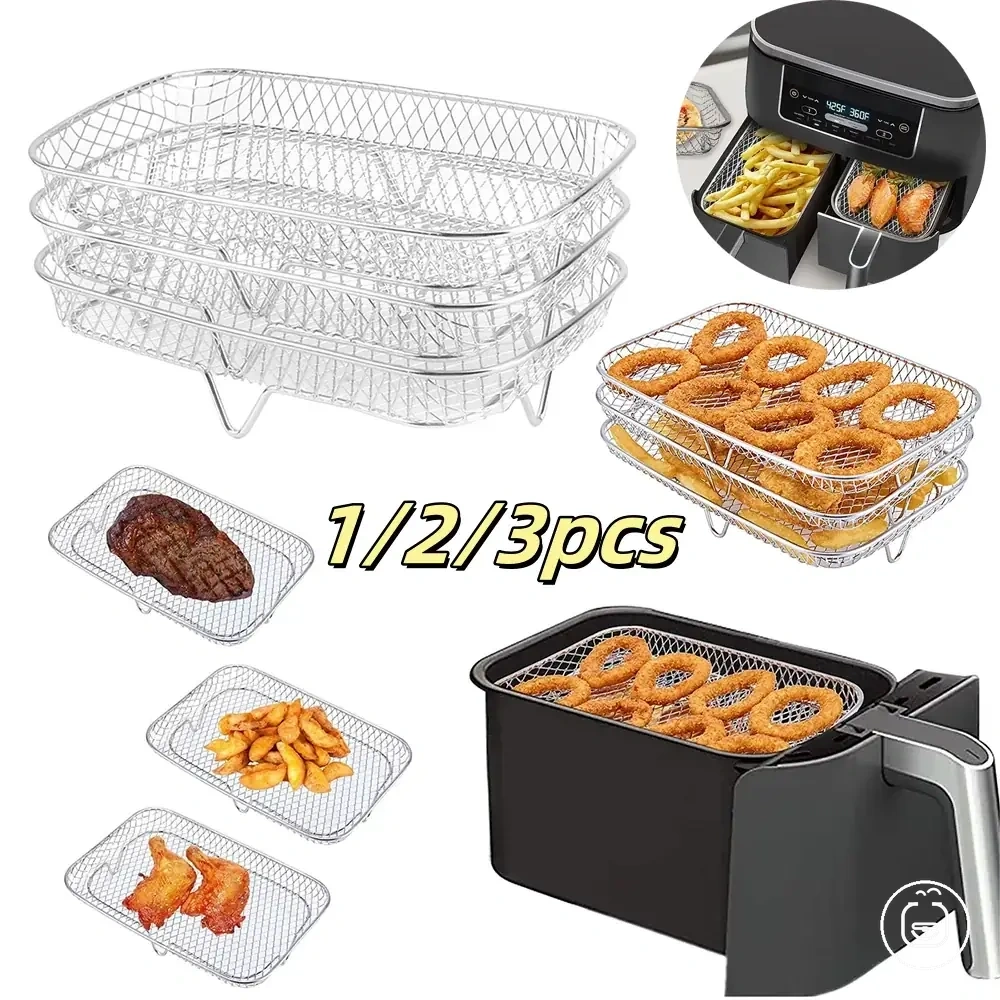
Rack, crisper plate, and perforated insert accessories support crisping through elevation and perforation. A rack uses elevation to improve airflow around more food surfaces, while a crisper plate uses a hole pattern that may support surface drying and browning. A perforated insert can help preserve spacing and exposure, although results may be limited when openings are blocked or food moisture remains high. When comparing crisping accessories, consider the following checklist:
- Elevation: A rack or raised rack increases food exposure by lifting food above the basket surface.
- Perforation: A crisper plate or perforated insert uses a hole pattern that may support surface drying.
- Food spacing: Separation between pieces helps maintain airflow and exposed surface area.
- Food moisture: Higher moisture levels can increase sogginess risk regardless of accessory choice.
- Quantity: Crowding the basket may reduce air circulation and limit crisping support.
- Clearance: Adequate space around the accessory helps preserve airflow through the basket.
When food is crowded or benefits from more exposure, a rack may help by improving elevation and airflow around the food. When food already sits in a single layer with sufficient spacing, the flat basket surface may be enough. For users interested in using accessories for cooking, accessory selection should be based on airflow, spacing, moisture level, and available clearance rather than an expectation of guaranteed crispness.
This chart shows the main types of crisping accessories and the key factors to consider when choosing between them.
Racks, Crisper Plates, and Perforated Inserts
Racks, crisper plates, and perforated inserts differ by whether they use elevation, perforation, or a combination of both to change airflow contact around food. A rack is a raised support that creates elevation, while a crisper plate and perforated insert use perforation to expose more surface area to moving air. These attributes interact with food condition, moisture, and clearance in different ways, which can influence the crisping benefit and limitation of each accessory.
| Accessory | Airflow Attribute | Best Food Condition | Limitation |
|---|---|---|---|
| Rack | Elevation increases airflow contact around more food surfaces | Foods that benefit from exposure above the basket surface | Crisping benefit may be reduced when clearance is limited or airflow becomes blocked |
| Crisper plate | Perforation supports surface drying through a patterned base | Foods with moderate moisture where air can reach the underside | Surface drying may be limited when perforations are covered |
| Perforated insert | Perforation combines airflow contact with food separation | Foods that benefit from spacing and exposure | Results may vary when food moisture is high or spacing is restricted |
When food condition includes more moisture, a crisper plate or perforated insert may support surface drying if perforation remains open. When broader airflow contact around multiple sides is the goal, a rack provides elevation rather than additional perforation. Each accessory has a limitation because fit, clearance, food condition, and airflow access can influence the crisping benefit.
Accessories for Cleanup and Mess Control
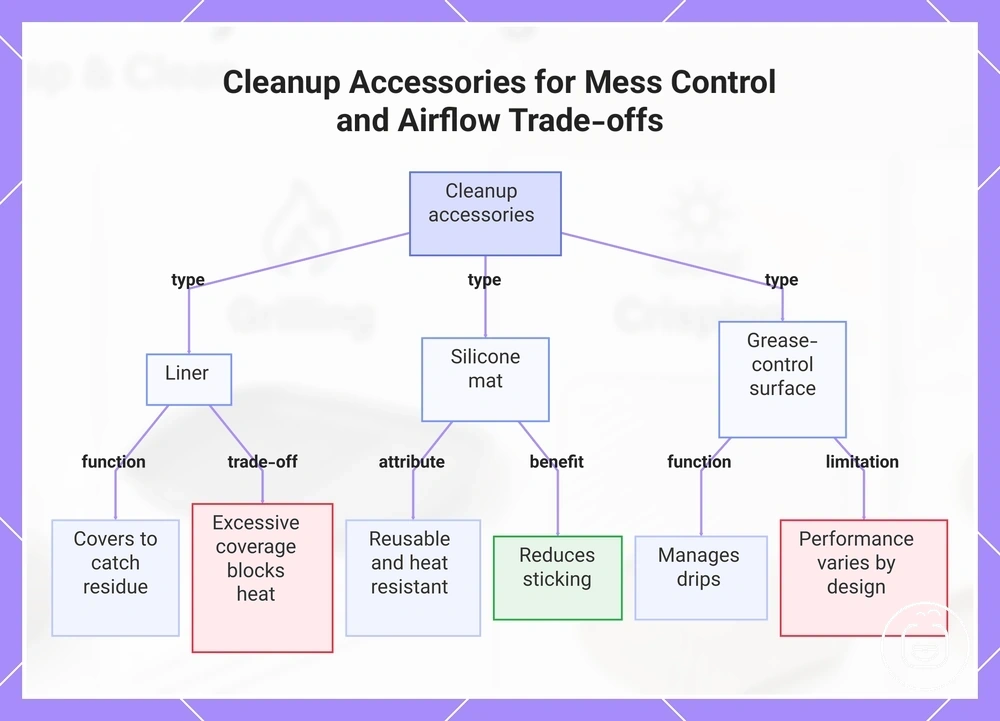
When cooking messy, sticky, or greasy foods, cleanup accessories can reduce residue, sticking, and drips from collecting directly on the basket surface. A liner, silicone mat, or grease-control surface creates a barrier that may lower the cleaning burden after cooking. These accessories help with mess control, but their effectiveness depends on coverage, perforation, and stability. Too much coverage or a poor fit can create an airflow trade-off by limiting heat movement through the basket.
A liner focuses on coverage to catch residue and drips, while a silicone mat combines reuse, heat resistance, and surface separation that may reduce sticking. A grease-control surface helps manage drips before they accumulate on the basket, although performance can vary with food condition and accessory design. Cleanup and mess control depend on balancing residue reduction with airflow preservation. Consider the following factors when comparing cleanup-focused accessories:
- Coverage: Greater coverage can contain more residue and drips but may reduce airflow if large areas are blocked.
- Perforation: Openings help preserve airflow while supporting cleanup and mess control.
- Heat resistance: Materials should remain suitable for the intended cooking environment.
- Stability: A stable accessory is less likely to shift and affect food contact or residue collection.
- Reusability: A silicone mat or reusable mat may reduce ongoing cleaning effort across repeated use.
- Fit: Basket fit influences both airflow preservation and mess-control performance.
Cleanup accessories can make residue management more convenient, but they do not eliminate the need for proper cleaning. The key trade-off is convenience versus airflow preservation. Coverage, perforation, and model fit should be balanced to reduce residue without unnecessarily restricting heat movement.
This chart shows the three main types of cleanup accessories—liner, silicone mat, and grease-control surface—and their key functions and trade-offs for balancing mess control and airflow preservation.
Liners, Silicone Mats, and Grease-Control Surfaces
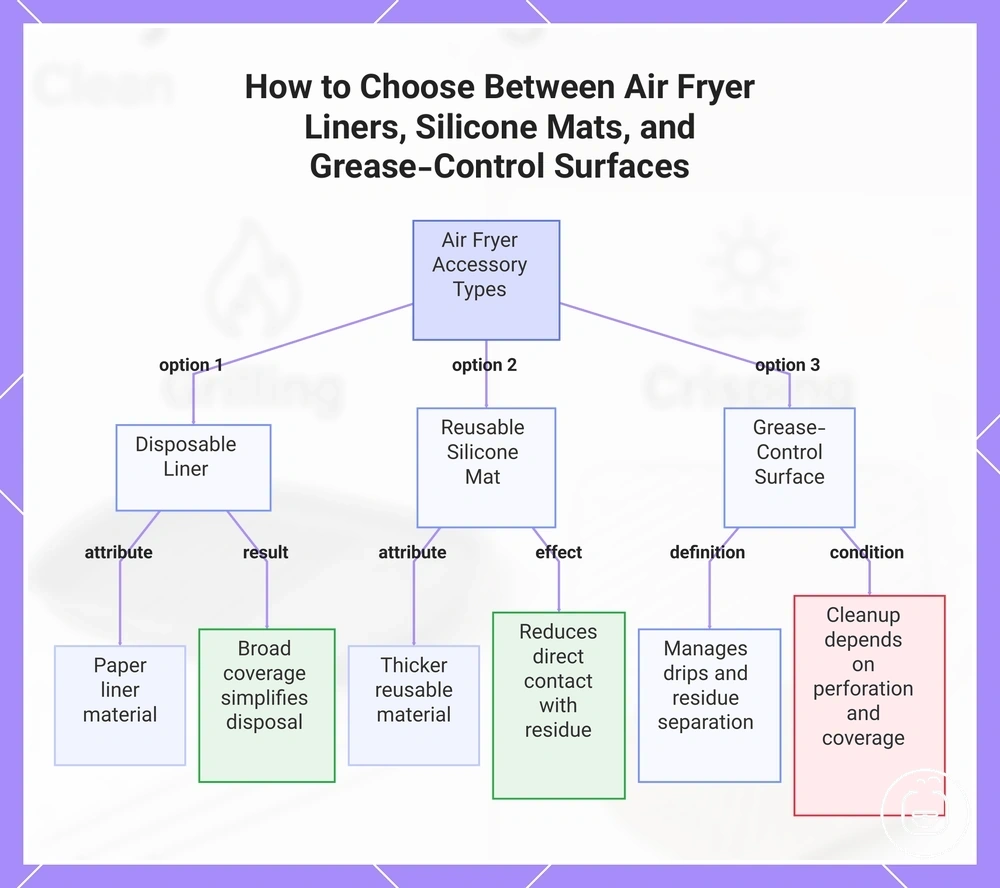
Liners, silicone mats, and grease-control surfaces differ by material, reusability, perforation, and basket coverage. A liner is typically a disposable surface designed to collect residue, while a silicone mat is a reusable accessory with greater thickness and repeated-use potential. A grease-control surface focuses on separating drips from food-contact areas, and its airflow effect depends on perforation and coverage.
- Disposable liner: Usually a paper liner with broad basket coverage that can help contain residue and simplify disposal after cooking. Airflow effect may vary when perforation is limited or coverage is extensive.
- Reusable silicone mat: A reusable silicone mat uses a thicker material than a paper liner and may reduce direct contact between residue and the basket. Reuse value depends on condition, maintenance, and continued suitability for cooking use.
- Grease-control surface: Designed to manage drips and separate accumulated residue from food. Cleanup may become easier when drips collect away from the primary food-contact area.
- Perforation and basket coverage: Perforation can help preserve airflow, while greater basket coverage may improve mess reduction but can also change airflow effect within the basket.
When repeated use is preferred, a reusable silicone mat may provide ongoing convenience through reuse and material durability. When quick residue removal is the goal, a disposable liner can simplify cleanup handling after cooking. Cleanup outcomes still depend on perforation, basket coverage, and airflow effect because excessive coverage may restrict air movement around the food.
This chart compares three air fryer accessory types—disposable liner, reusable silicone mat, and grease-control surface—highlighting their material, reusability, and the impact of perforation and basket coverage on airflow and cleanup.
Accessories for Oil Control and Better Surface Coverage
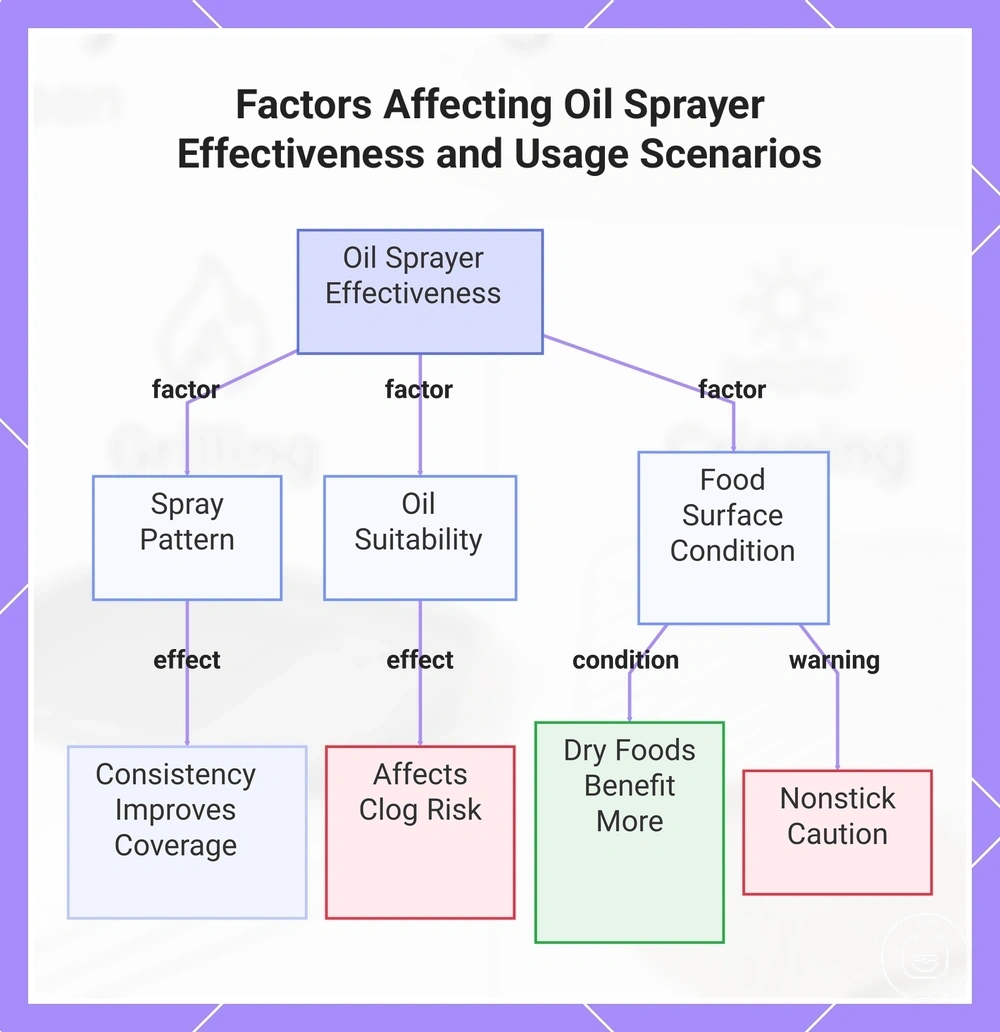
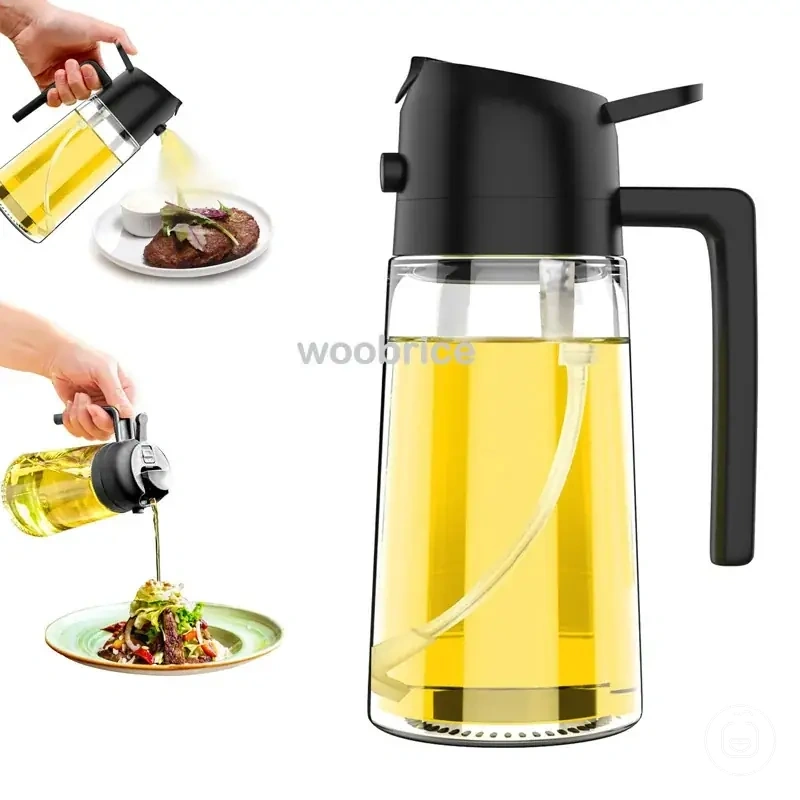
An oil sprayer or mister helps only when a light, even surface coverage improves the food surface. It applies a controlled coating that may support browning or sticking control in certain cooking situations. Whether oil is needed depends on the food condition, cooking goal, and existing surface fat.
An oil sprayer or oil mister uses a spray pattern to distribute oil across the food surface, which can influence coating consistency. Oil suitability matters because different oils may affect spray performance, while the pump mechanism can influence how evenly the coating is applied. Oil control depends on spray pattern, oil type suitability, cleaning need, and food surface. Consider the following factors when selecting a refillable sprayer or spray bottle:
- Spray pattern: A consistent spray pattern may improve surface coverage across larger food surfaces.
- Oil suitability: Oil type can influence spray consistency and may affect clog risk within the pump mechanism.
- Cleaning need: Residue buildup may reduce spray performance over time and can require periodic cleaning.
- Food surface: Dry foods may benefit more from a light coating than foods that already contain visible fat.
- Nonstick caution: Surface coverage may support sticking control, but results depend on coating consistency and food condition.
When cooking breaded foods or foods with a dry surface, a mister may help create more even browning and improved sticking control through light coating. When cooking already-fatty foods, additional oil may provide limited change because surface coverage is already present. The decision depends on whether coating consistency changes the browning or sticking outcome for that specific food.
This chart shows the key factors that determine oil sprayer effectiveness and how food surface conditions influence whether coating improves browning and sticking control.
Oil Sprayers, Misters, and Light-Coating Use Cases
An oil sprayer or mister creates a light coating through controlled application, while oil-heavy cooking relies on larger amounts applied by pouring or brushing. The difference is not the presence of oil but the level of coverage control. An oil sprayer helps distribute a thinner layer across the food surface, which may support more consistent browning or sticking control when surface coverage matters.
- Mist fineness: A fine mist can improve coverage by spreading oil more evenly across the food surface, which may influence coating quality.
- Clog risk: Clog risk may increase when oil compatibility and sprayer design do not work well together, potentially affecting spray consistency.
- Oil compatibility: Oil compatibility can influence how effectively an oil sprayer, refillable mister, or spray bottle produces a consistent coating.
- Cleaning need: Cleaning need may increase when residue builds up inside the spray path or pump mechanism, which can affect usability over time.
- Coverage control: An oil sprayer or mister provides more controlled coverage than pouring, although coating quality still depends on spray performance and food condition.
Sprayer usability depends on mist fineness, clog risk, oil compatibility, and cleaning need. When mist quality remains consistent, a light coating may support more even browning and sticking control. A refillable mister can require periodic cleaning because residue buildup may affect spray performance and coating consistency.
Choosing Single-Need Accessories Versus Multi-Use Accessories
Select a single-need accessory when repeated use benefits from precision and a specific cooking pattern. Consider a multi-use accessory when versatility, storage limits, and broader use cases matter more. Frequency, storage, fit risk, cleanup burden, and value shape this decision.
| Option | Best use case | Trade-off | Decision signal |
|---|---|---|---|
| Single-need accessory | Repeated baking, grilling, crisping, or another specific task | Lower versatility and dedicated storage requirements | Prioritize when frequency is high and precision matters |
| Multi-use accessory | Mixed cooking patterns that require broader functionality | May not provide the same task-specific focus as a dedicated accessory | Consider when versatility and storage efficiency are more important |
When baking, grilling, crisping, or cleanup tasks occur frequently, a dedicated accessory may provide more consistent support for that repeated activity. When cooking needs change from meal to meal, a multi-use accessory or multi-purpose tool can reduce the need for separate accessories. The choice depends on how often the same cooking pattern repeats and whether versatility adds practical value. Frequency helps determine which accessory type deserves priority.
Storage limits and fit risk can influence the purchase path as much as cooking performance. A larger accessory set may not provide more value if rarely used or difficult to store. Before expanding beyond core needs, review essential accessory choices and compare basket size, storage space, and expected use frequency. Fit risk should be evaluated as part of the decision rather than after purchase.
Buy, skip, or prioritize decisions depend on cooking pattern rather than accessory count. A single-need accessory may be worth considering when repeated use justifies dedicated functionality. A multi-use accessory may be enough when versatility reduces storage burden and supports multiple tasks.
When cooking habits are predictable, dedicated accessories can align more closely with specific needs. When cooking habits vary, a versatile accessory may offer broader coverage with fewer storage demands. The following product examples are illustrative and should be viewed as selection support rather than recommendations.
The products below are useful examples for comparing available options. Before buying, check that the compatibility criteria, key features, and product details match your needs.

Fit, Material, and Airflow Checks Before Choosing
Final selection needs fit, material, and airflow checks before an accessory is treated as suitable. A cooking-need match can still become risky if size, shape, clearance, or air circulation does not suit the basket. These checks act as the final filter before choosing.
Fit starts with size, shape, and clearance inside the basket. An accessory that matches the cooking need may still be unsuitable if the shape crowds the basket or leaves too little clearance above the food. Raised accessories need extra space because height can affect loading and removal. Flat accessories also need a fit check because a wide insert may block usable basket area.
Material means the accessory should use a heat-safe material appropriate for the cooking environment. Heat-safe material matters because unsuitable material can create risk when exposed to cooking heat. Stability is also part of the material and design check because a thin, flexible, or poorly supported accessory may shift under food load. A stable accessory is more likely to keep food position, clearance, and basket contact predictable.
Airflow depends on how accessory shape, perforation, and food load affect movement through the basket. Perforation can help preserve airflow, but covered holes, oversized liners, or crowded raised inserts may reduce air circulation and change the cooking result. Use the table below as a final compatibility check before treating an accessory as suitable. For a broader purchase screen beyond this cooking-need filter, use the buying checklist.
| Check | What to verify | Risk if ignored | Decision |
|---|---|---|---|
| Fit | Size, shape, and basket clearance | Poor fit can crowd the basket or make handling difficult | Compatible when the accessory sits securely with usable space |
| Material | Heat-safe material for cooking use | Unsuitable material may create risk under heat | Risky or unsuitable when material suitability is unclear |
| Airflow | Air circulation around food and accessory edges | Blocked airflow may affect cooking results | Compatible when air can move around the accessory |
| Perforation | Openings remain exposed during cooking | Covered perforation can reduce airflow benefits | Risky when food or liner coverage blocks openings |
| Stability | Accessory support under food load | Unstable placement can shift food or reduce clearance | Unsuitable when the load cannot sit securely |
Boundary examples help keep this screen focused without replacing dedicated compatibility or materials guidance. A round pan may fit one basket shape but leave poor side clearance in another, while a raised rack may suit crisping only if the height does not crowd the food. A liner with limited perforation may help cleanup but become risky for airflow if coverage blocks too much of the basket.
Choose the accessory only after fit, material, airflow, perforation, and stability pass the local check. If one condition is unclear, the accessory should be treated as risky until the basket and material details are verified. Product examples after this point are illustrative selection support, not proof of fit or suitability.
The products below are useful examples for comparing available options. Before buying, check that the compatibility criteria, key features, and product details match your needs.