
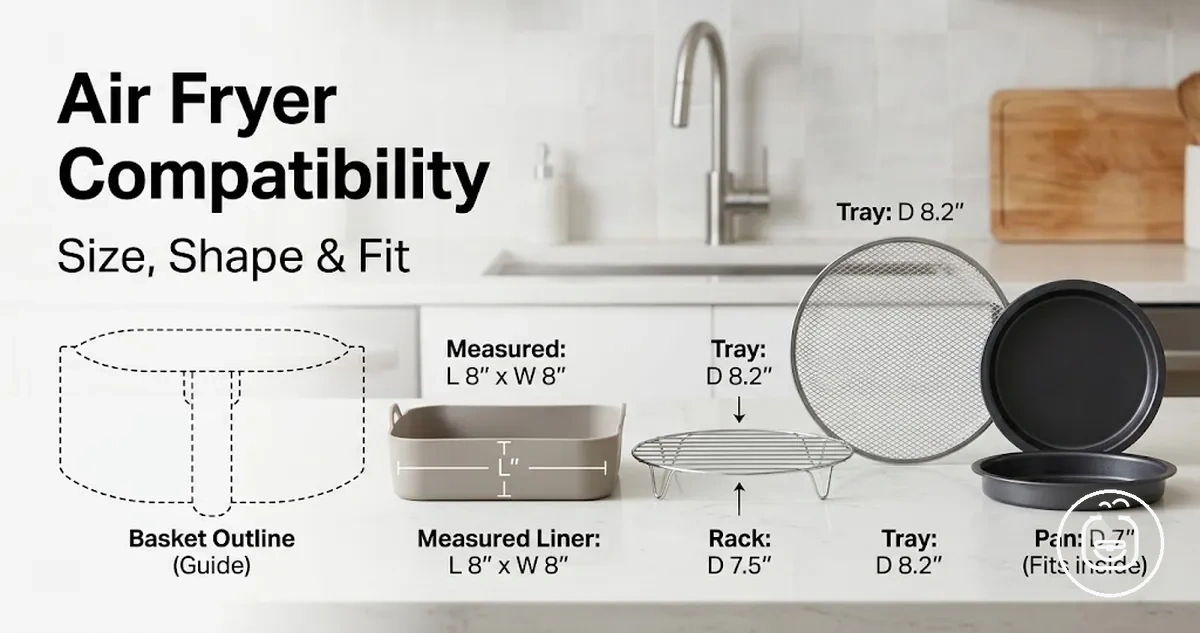
Air fryer accessories compatibility guide for size, shape, and basket fit
Air fryer accessories compatibility for basket fit depends on basket size, shape, clearance, and internal dimensions. It is the relationship between an accessory’s footprint and the air fryer basket interior that determines whether it can sit and function without obstruction. This includes how much usable height is available and whether airflow pathways remain open during placement. Compatibility is therefore a fit-and-clearance condition rather than a fixed universal rule across all models.
In many real situations, compatibility becomes clearer when you move from general assumptions to measured context inside the appliance, as outlined in the air fryer accessories guide. Different basket shapes such as round, square, or rectangular can change how the same accessory behaves in practice. This is why internal dimensions and airflow space matter more than external appearance or stated capacity labels when evaluating accessory fit.
Before checking specific accessory options, it helps to clarify the key compatibility checkpoints:
- Internal basket width, depth, and usable height
- Clearance space for handles, racks, and raised edges
- Shape alignment between basket and accessory footprint
- Airflow space around the accessory during placement
- Variation in fit across different air fryer models
When these conditions are reviewed together, compatibility becomes a structured decision based on physical constraints rather than assumptions. Even small differences in internal dimensions or accessory design can influence how securely and safely an item fits inside the basket. This makes measured evaluation the most reliable way to understand whether an accessory is suitable for a specific air fryer setup.
What compatibility means for air fryer accessories
Air fryer accessory compatibility is an IS-condition where an accessory matches the basket fit, clearance, and safe placement requirements of a specific air fryer. It means the accessory must align with internal dimensions so it can sit properly inside the basket without obstruction. Compatibility depends on size, shape, usable height, airflow space, and model limits rather than external appearance or capacity labels.
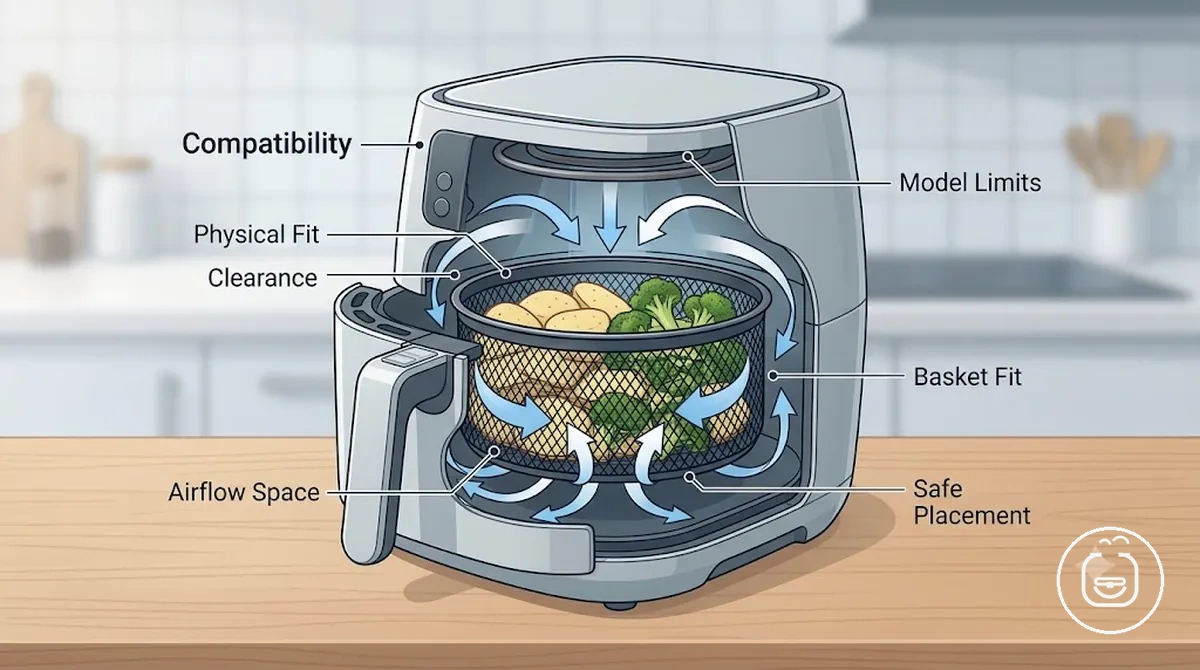
This compatibility is primarily about physical fit inside the basket and how the accessory interacts with clearance around the walls and base. Even when an accessory fits in width and depth, usable height and handle clearance can still affect safe placement. Airflow space is also critical because restricted circulation may reduce even heat movement around the accessory.
Physical compatibility is separate from material safety or cooking usefulness. An accessory may fit correctly inside the basket but still require separate consideration for heat resistance or food-contact safety. This distinction keeps compatibility focused on physical fit while treating safety as a supporting boundary condition.
Basket size signals that determine accessory fit
Basket size signals determine accessory fit by describing the internal space available inside an air fryer basket. These signals include internal width, depth, usable height, bottom area, rim taper, and stated capacity. Together, they define how much physical space an accessory can occupy without blocking placement or movement. Fit depends on these internal measurements rather than external appliance size.
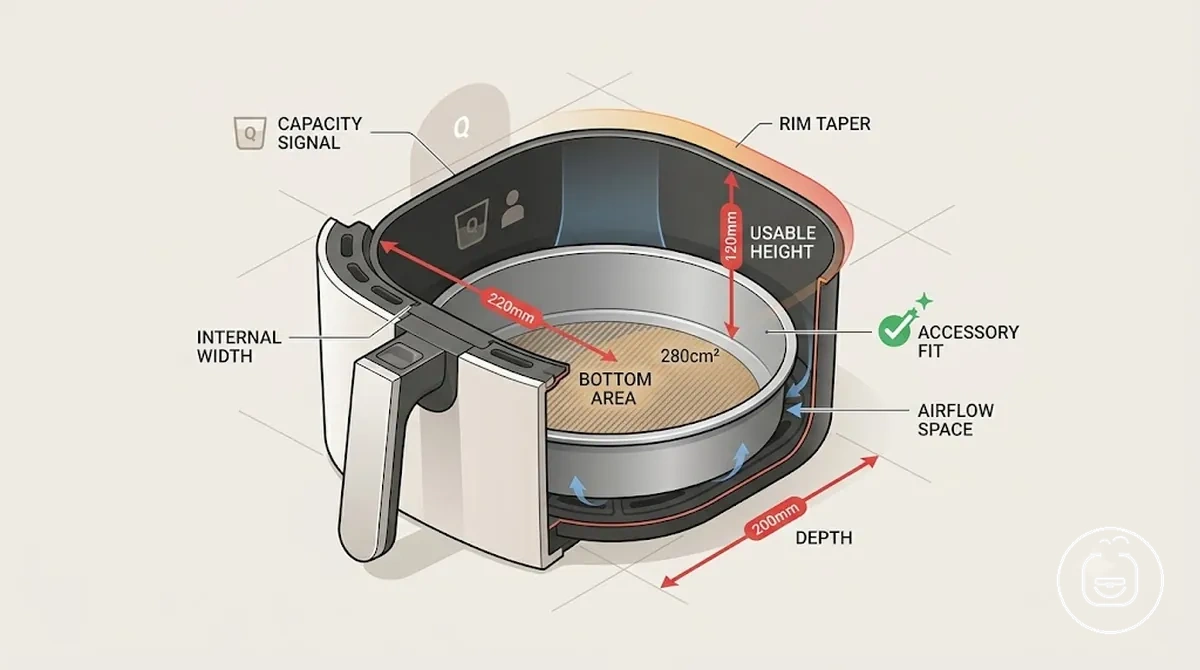
Key basket size signals can be grouped into measurable internal attributes and capacity references used as a general guide.
| Measurement signal | What to record | Why it affects fit |
|---|---|---|
| Internal width | Side-to-side basket space | Determines accessory footprint fit across the basket |
| Depth | Front-to-back internal length | Affects how far an accessory can sit without obstruction |
| Usable height | Vertical space to heating element | Limits taller accessories and stacked placement |
| Bottom area | Flat base surface inside basket | Controls stability and contact surface of accessory |
| Rim taper | Change in width toward top opening | Can reduce usable space compared to base measurements |
| Capacity (quart/litre) | Stated volume rating | Only a general indicator, not exact internal dimensions |
Air fryers with the same capacity can still require different accessory sizes because internal width, depth, and rim taper may vary by design. This means two units with similar quart or litre ratings can have different real internal space, which directly changes accessory fit and usable clearance inside the basket.
Internal width, depth, and usable height
Internal width, depth, and usable height determine how an accessory fits inside the air fryer basket. These inside measurements define the real space available for placement and movement. They are more important than outside dimensions because they reflect the actual usable area for accessory fit and clearance limits.
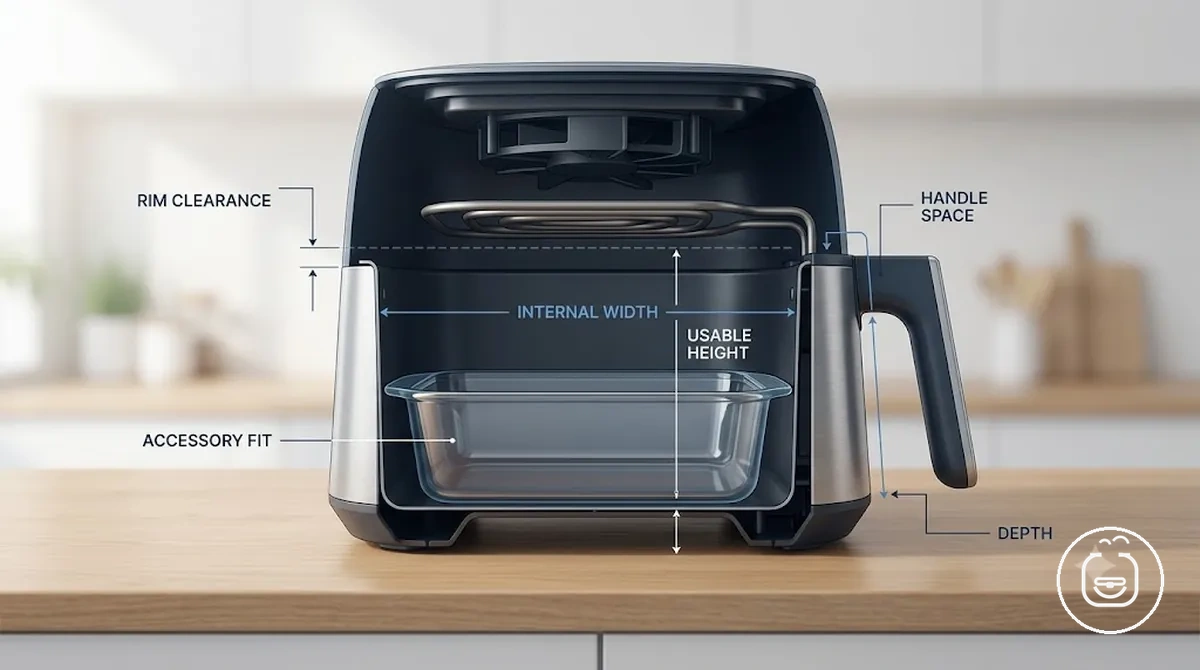
Internal width, depth, and usable height work together to define how an accessory sits inside the basket without contact or blockage.
- Base width and basket depth define the horizontal footprint available for accessory placement
- Usable height and accessory height determine vertical clearance inside the basket
- Rim clearance affects whether taller or lifted accessories can fit safely
- Handle space influences whether accessories block movement or removal
- Rounded-corner effects can reduce usable space compared to straight-wall expectations, so exterior dimensions are not enough for reliable fit judgment
Quart or litre capacity versus actual basket dimensions
Quart or litre capacity is a rough sizing signal that does not directly determine accessory fit inside an air fryer basket. The quart capacity and litre capacity mainly describe volume, while actual fit depends on internal width, depth, and usable height. This makes the stated capacity a secondary indicator compared to real basket dimensions when evaluating compatibility.
Capacity labels must be read as a general range signal, not a direct fit rule. The relationship between capacity label and fit is influenced by structural factors inside the basket.
| Capacity label can suggest | Capacity label cannot prove |
|---|---|
| Approximate basket size class based on quart capacity or litre capacity | Exact accessory diameter or accessory width compatibility |
| General expectation of cooking volume | Actual basket footprint for accessory placement |
| Broad comparison between models with similar stated capacity | Consistency of wall taper and rounded corners across models |
| Rough size grouping of appliances | Precise internal dimensions required for reliable accessory fit |
Because basket footprint, wall taper, and rounded corners vary between models, two air fryers with similar quart or litre capacity may still require different accessory dimensions. Actual internal measurements remain the deciding factor over capacity labels when assessing fit conditions.
Round, square, and rectangular basket shape matching
Basket shape affects how an air fryer accessory fits by changing how the accessory outline interacts with internal space. A round basket, square basket, or rectangular basket distributes space differently across edges, corners, and depth, which directly influences accessory outline alignment, base contact, rim clearance, and airflow gaps. Shape matching improves placement stability, but it always works alongside actual size constraints.
Round, square, and rectangular baskets create different fit behaviors based on how corners and edges are used during placement.
| Basket shape | Accessory shape signal | Fit strength | Fit limit |
|---|---|---|---|
| Round basket | Best aligned with circular accessory outline and round diameter movement | Stable central placement | Limited corner use |
| Square basket | Supports square footprint with effective corner use and base contact | Efficient space use | Rounded accessories may leave side gaps |
| Rectangular basket | Supports elongated accessory footprint across depth and width direction | Strong directional fit | Uneven rim clearance in narrow edges |
Shape matching helps reduce wasted space and improves airflow balance, but it does not replace internal width, depth, or usable height measurements. Fit still depends on actual dimensions, rim clearance, and airflow gaps, especially when using racks, trays, or inserts from different accessory types and shapes.
Round accessories in round baskets
Round accessories in round baskets depend on how closely the accessory diameter aligns with the basket diameter and how much usable clearance exists along the sidewall taper. A circular fit alone does not guarantee proper placement because internal geometry still influences stability, airflow gaps, and contact with the basket walls. Even small differences in rim clearance or handle space can affect how securely a round accessory sits.
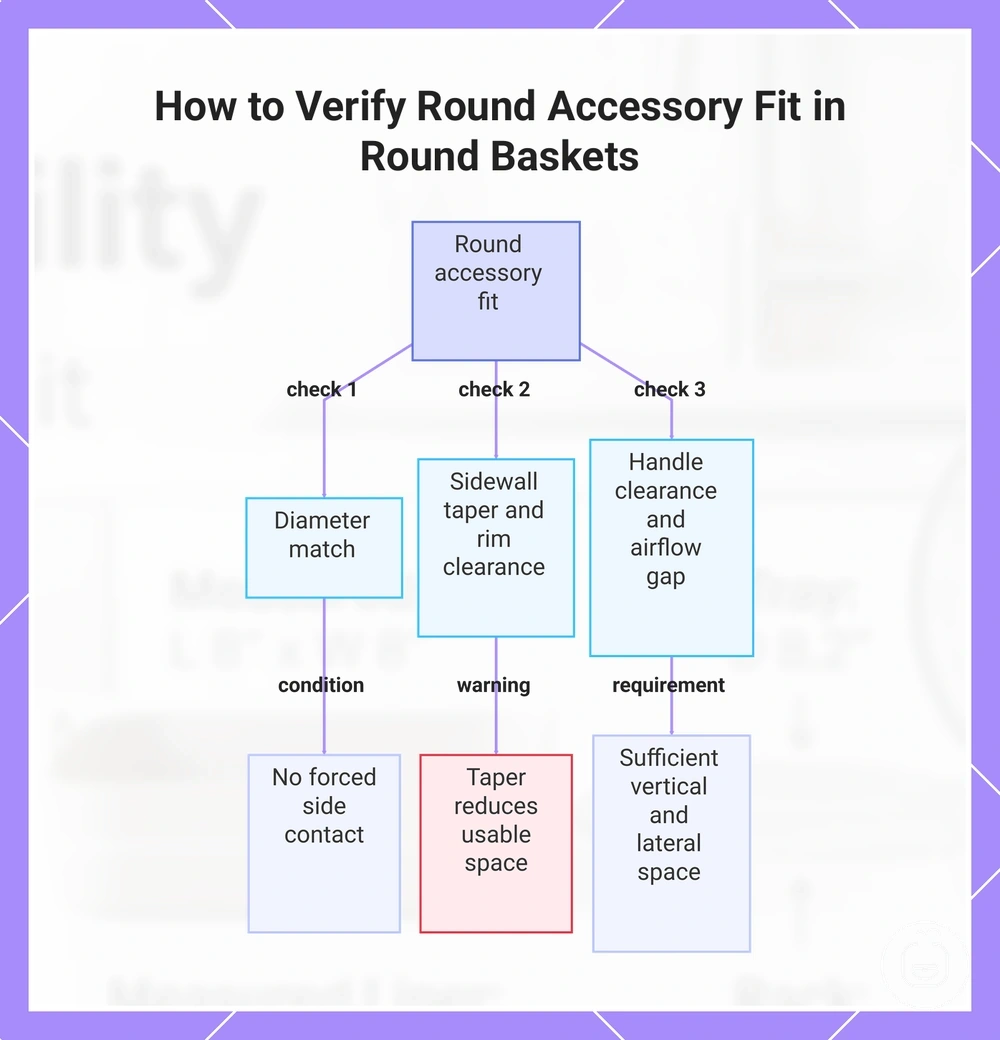
Fit conditions should be verified through a few key checks before assuming compatibility:
- Diameter match: The round accessory diameter should align with the basket diameter without forcing side contact.
- Sidewall taper and rim clearance: Tapered walls or narrowing near the rim may reduce usable space even in round baskets.
- Handle clearance and airflow gap: Sufficient vertical and lateral space is needed to maintain airflow and avoid obstruction from circular liners or round racks.
This chart shows the three key checks needed to ensure a round accessory fits properly in a round basket, including diameter alignment, sidewall taper, and handle clearance.
Square accessories in square or rectangular baskets
Square accessories in square baskets depend on width alignment and how the footprint interacts with corners, depth, rounded corners, handle placement, and height clearance. In square baskets, corner use is more efficient because the square accessory outline can sit closer to edges with stronger base contact. In rectangular baskets, the same square accessory may fit in width but create corner gaps due to differences in depth distribution and internal geometry.
Square versus rectangular fit behavior changes based on how the footprint is supported by basket shape rather than shape similarity alone.
| Square baskets | Rectangular baskets |
|---|---|
| Square accessories align with width and improve corner use and base contact | Square accessories may fit width but leave corner gaps due to depth mismatch |
| Rounded corners can slightly reduce usable edge space | Elongated structure can affect uniform contact across the basket |
| Handle placement and height clearance affect vertical stability | Airflow gaps may vary due to longer internal depth distribution |
How to measure an air fryer basket for accessories
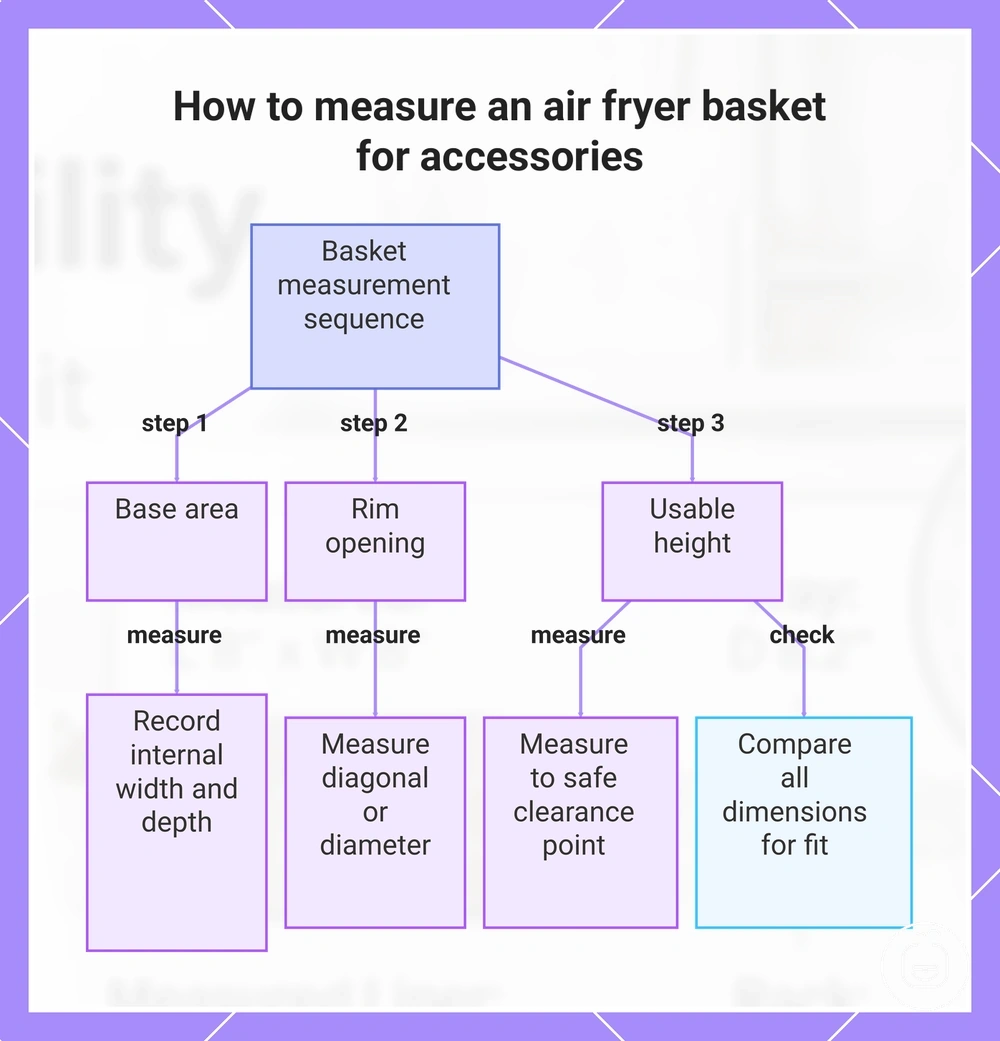
Measure the inside basket base, rim opening, and usable height before choosing an accessory. This measurement sequence ensures the internal width, internal depth, and height clearance are captured together so accessory dimensions can be evaluated against real basket constraints rather than external size assumptions.
Incorrect fit usually occurs when only one inside measurement is considered. A complete measurement sequence reduces mismatch risk by covering all critical geometry: base area, top opening variation, and vertical clearance up to the heating zone.
- Measure the basket base using a ruler or tape measure to record internal width and internal depth, which define the usable base area for accessories.
- Measure the rim opening at the top (inside measurement) to account for narrowing or expansion that may differ from the base shape.
- Record diagonal or diameter where relevant to understand round or corner-to-corner placement limits inside the basket.
- Measure usable height from the basket base to the safe clearance point below the heating area to ensure vertical fit.
- Note all values in centimetres and inches so accessory dimensions can be compared consistently across measurement systems.
Compare recorded basket measurements against accessory dimensions by matching base width/depth, rim opening constraints, diagonal or diameter alignment, and usable height clearance. Fit depends on how these recorded dimensions interact with accessory geometry, so comparison should be treated as a compatibility check rather than a guarantee.
This chart outlines the three critical measurement steps for an air fryer basket and the final compatibility check to ensure accessory fit.
Measuring the base, rim, and clearance height
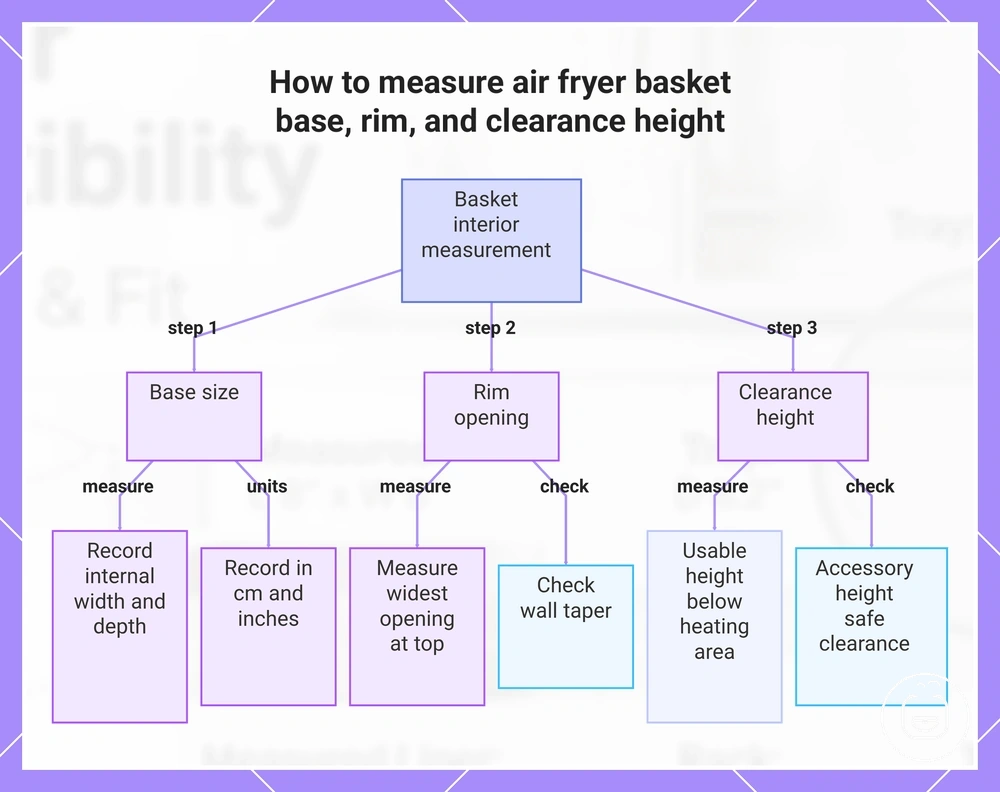
Measuring the base, rim, and clearance height depends on recording three core inside points of the air fryer basket: flat base size, widest rim opening, and usable height up to the heating area. These measurements define how base, rim, and clearance height work together as a single sequence for understanding internal width, top opening variation, and vertical space limits.
This sequence ensures the key fit boundaries are captured without missing shape changes or height restrictions inside the basket.
- Measure the flat base size by recording internal width and internal depth across the basket bottom, forming the base-width-depth reference for fit.
- Measure the widest rim opening at the top to capture top opening variation and any narrowing caused by wall taper or basket design.
- Check wall taper by comparing base width with rim opening to understand how the basket shape changes from bottom to top.
- Measure accessory height alongside usable height to ensure clearance below the heating area is sufficient for safe placement space.
- Record all measurements in centimetres and inches to maintain consistent comparison when evaluating dimensions record-compare steps.
This chart shows the sequential process of measuring the three core interior points of an air fryer basket: flat base size, widest rim opening, and usable height clearance, including wall taper check and recording in both cm and inches.
Leaving space for handles, racks, and airflow
Clearance is a compatibility condition that remains necessary even when an accessory physically fits inside the air fryer basket. Handles, racks, and airflow require additional side and vertical space because handles protrude beyond the accessory body, rack legs extend downward, and liner walls or pan lip edges can restrict movement. Without this clearance, stacked accessories or tight placements may limit open air channels and reduce internal airflow balance within the basket space.
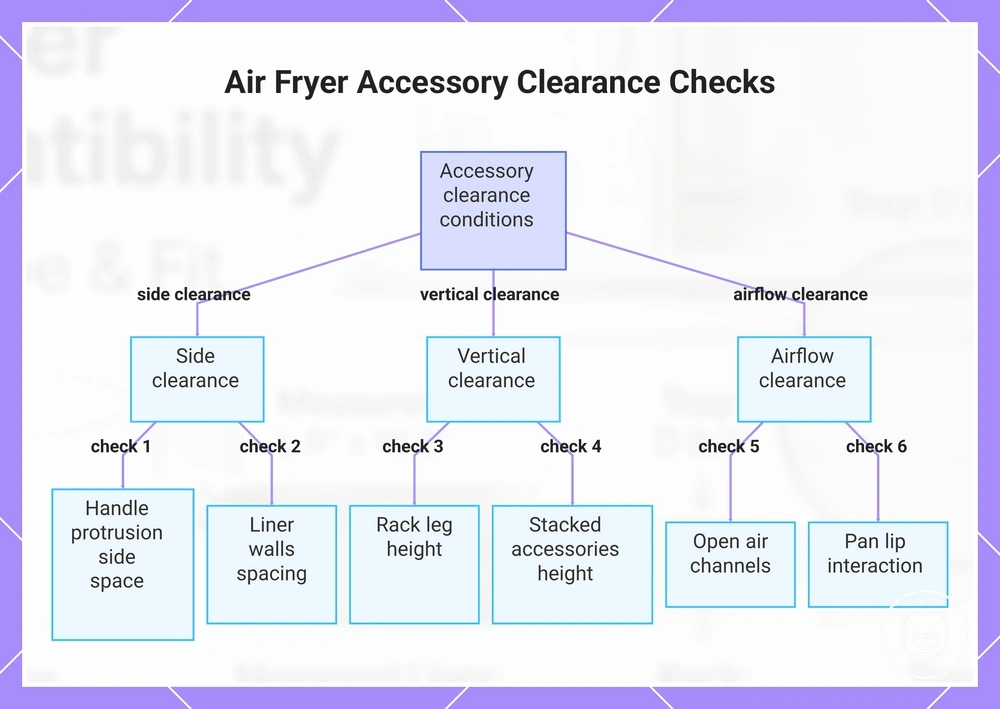
These clearance variables should be checked locally to ensure handles, racks, and airflow are not constrained during placement:
- Handles clearance: side space needed for handle protrusion without contact with basket walls
- Rack legs height: vertical space required so rack legs do not disrupt airflow or contact the base unevenly
- Pan lip interaction: rim edge condition that may affect stable placement inside liner walls
- Liner walls spacing: side boundary constraint influencing available clearance around accessories
- Stacked accessories height: vertical space needed when multiple accessories are placed together
- Open air channels: airflow gaps that must remain unobstructed for internal circulation balance
This chart shows the clearance variables that must be checked to ensure handles, racks, and airflow are not constrained when placing accessories in an air fryer basket.
Fit checks for liners, racks, pans, and basket inserts
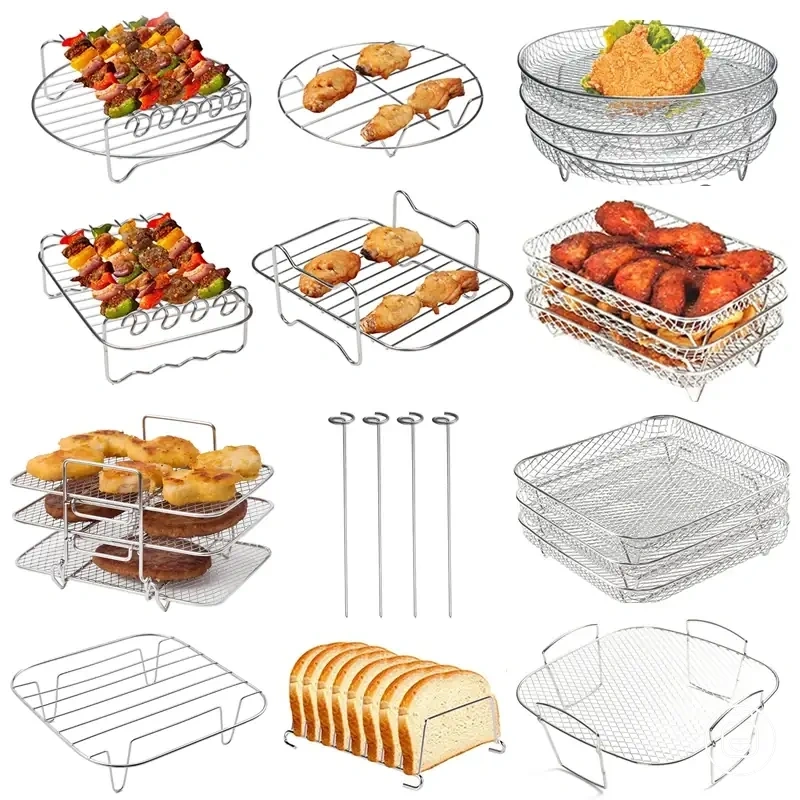
Fit checks for air fryer accessories depend on the accessory form because liners, silicone inserts, racks, pans, skewers, trays, and basket inserts each interact with the basket differently. Even when they target the same basket, the required fit attribute changes based on whether the accessory affects base coverage, vertical clearance, or airflow paths.
These differences require mapping each accessory form to a specific fit attribute, along with its condition to check and the resulting fit risk or decision cue during evaluation.
| Accessory form | Fit attribute | Value or condition to check | Fit risk or decision cue |
|---|---|---|---|
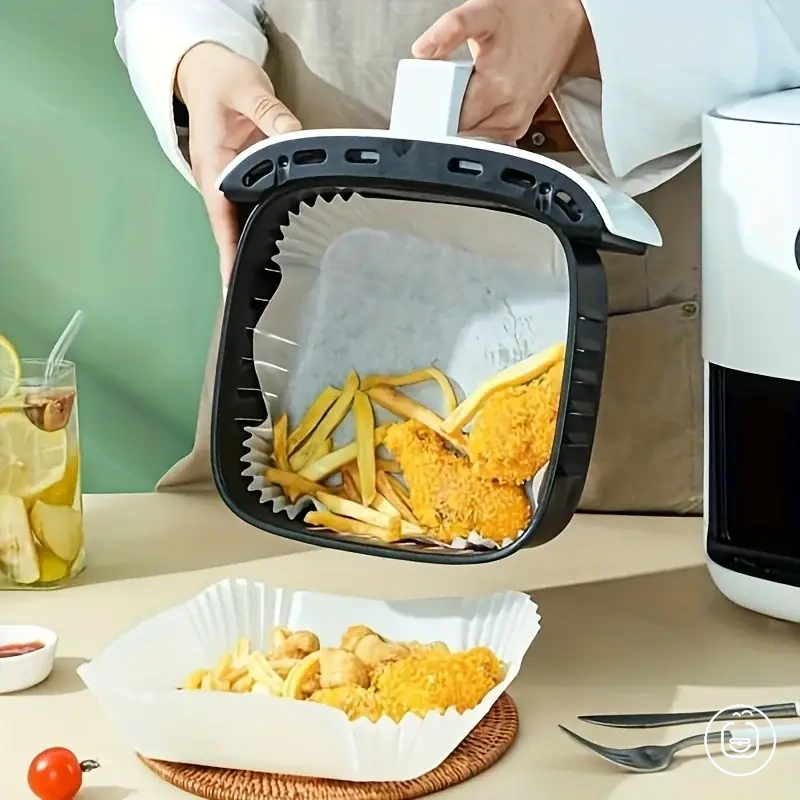
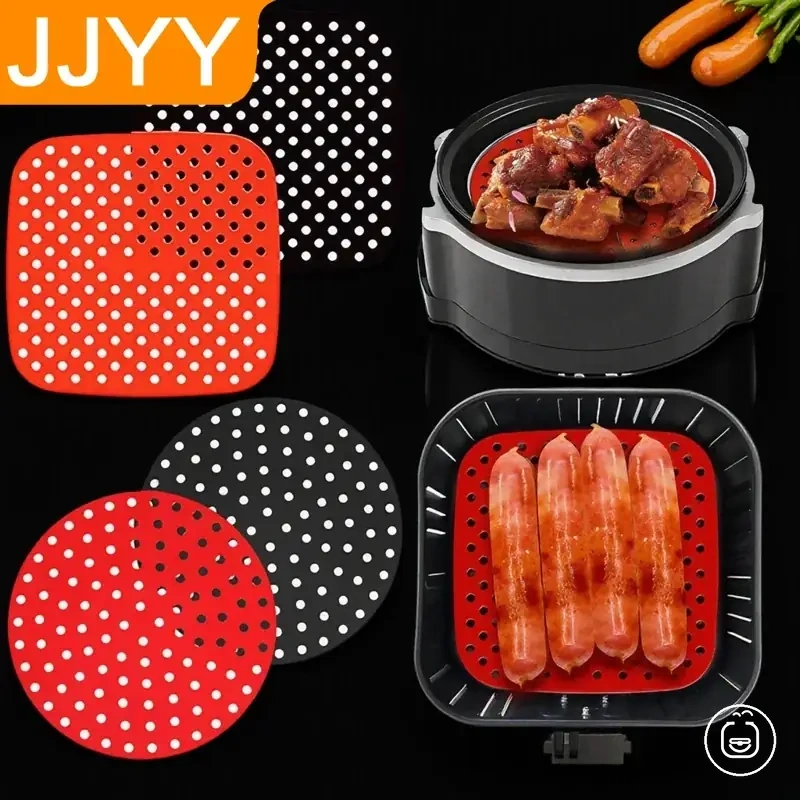
| Liners | Base coverage | Bottom footprint alignment and blocked holes risk at base level | May restrict airflow through basket base perforations |
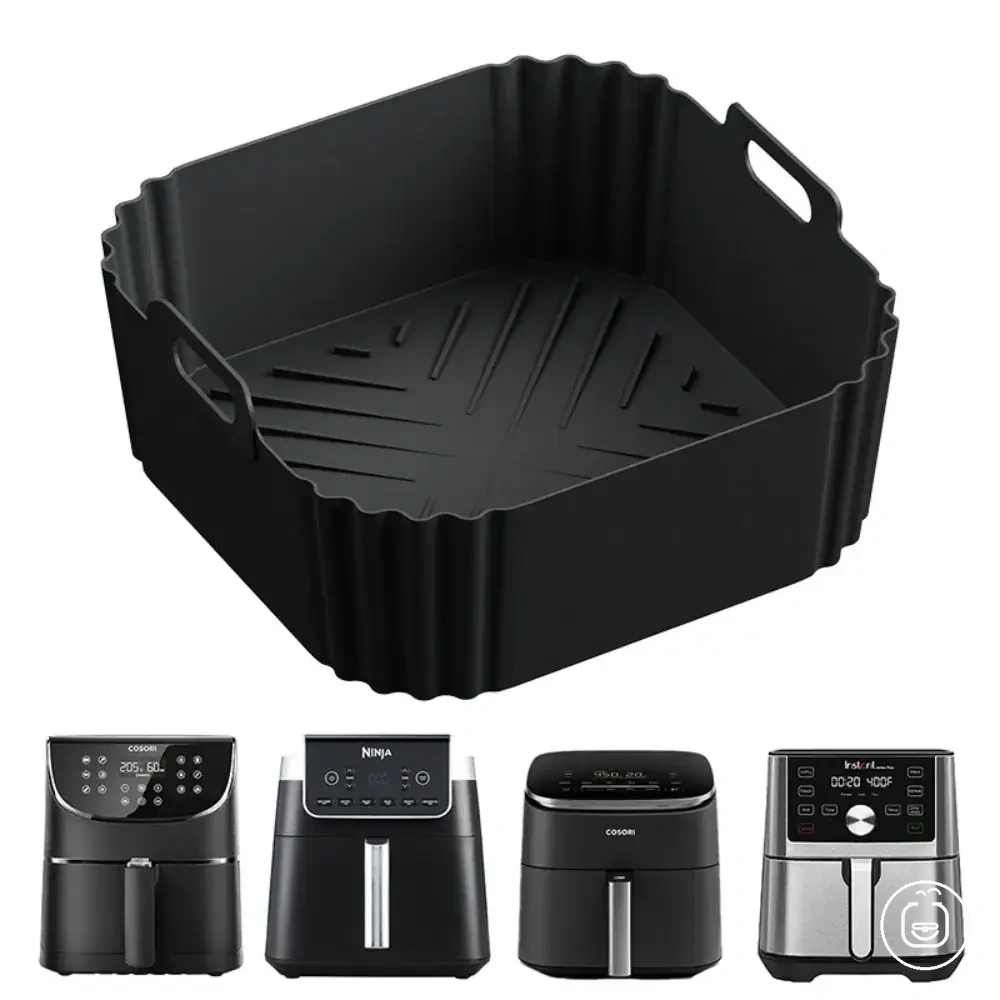
| Silicone inserts | Edge seating | Sidewall fit and stability against liner walls | Loose fit may reduce stable placement |
| Racks | Vertical clearance | Rack height and rack legs interaction with basket space | Can interfere with airflow when height exceeds clearance |
| Pans | Footprint alignment | Pan base size and pan lip interaction with basket rim | Rim contact may prevent proper seating |
| Skewers | Layer spacing | Vertical spacing and arrangement of multiple skewers | Overcrowding can reduce open air channels |
| Trays | Surface stability | Flat contact with basket base and edge balance | Uneven base contact may cause tilting |
| Basket inserts | Structural alignment | Overall insert shape fit within basket geometry | Mismatch may affect airflow distribution |
Material safety and heat resistance should be evaluated separately from fit conditions when assessing accessory performance; see safe accessory materials for material-level considerations.
Liners and silicone basket inserts
Liners and silicone basket inserts depend on base size, wall height, and corner shape alignment with the air fryer basket, since liners are flexible while silicone basket inserts are more structured. This difference changes how each accessory sits in the basket, especially around perforation or drainage pattern alignment, rim contact, and lifting tabs where present.
Fit checks for liners and silicone basket inserts focus on how the accessory settles inside the basket rather than only its nominal size. Key conditions include:
- Base size: must match basket floor area to reduce folding, edge lift, or blocked liner-base-corner contact
- Wall height: should align with basket depth to avoid collapse or excessive overextension
- Corner shape: must follow round or square basket geometry to prevent gaps or distortion
- Perforation / drainage pattern: should align with airflow paths to reduce blocked holes or restricted airflow
- Rim contact: should remain stable without interfering with seating inside the basket
- Lifting tabs: should remain accessible and not trapped under basket edges during placement
Fit performance may vary depending on basket design and accessory structure, so blocked perforation, folded edges, or rim pressure should be checked as local conditions before use.
Racks, pans, skewers, and layered accessories
Racks, pans, skewers, and layered accessories depend on combined footprint and vertical-clearance compatibility because these rigid or stacked structures occupy both base area and height inside the air fryer basket. Fit issues usually arise when rack width, pan shape, or layered positioning conflicts with leg height, pan lip clearance, skewer span, food height, or airflow path availability.
These accessories require local checks that evaluate how structure and stacking affect available space:
- Footprint (rack, pan, layered base): must align with basket width and depth without edge overhang or side contact
- Leg height: rack or stackable rack legs must stay within usable vertical clearance
- Pan lip clearance: rim edges should not interfere with basket walls or seating stability
- Skewer span: length must fit within internal width without bending or wall contact
- Food height: layered setup must remain below upper clearance limits of the basket
- Airflow path: stacked or layered accessories should not fully obstruct internal air movement routes
Smaller or lower-profile accessory configurations may reduce clearance pressure in constrained baskets, but actual fit always depends on basket geometry and stacking arrangement rather than a single fixed rule.
Universal accessory claims and model-specific compatibility
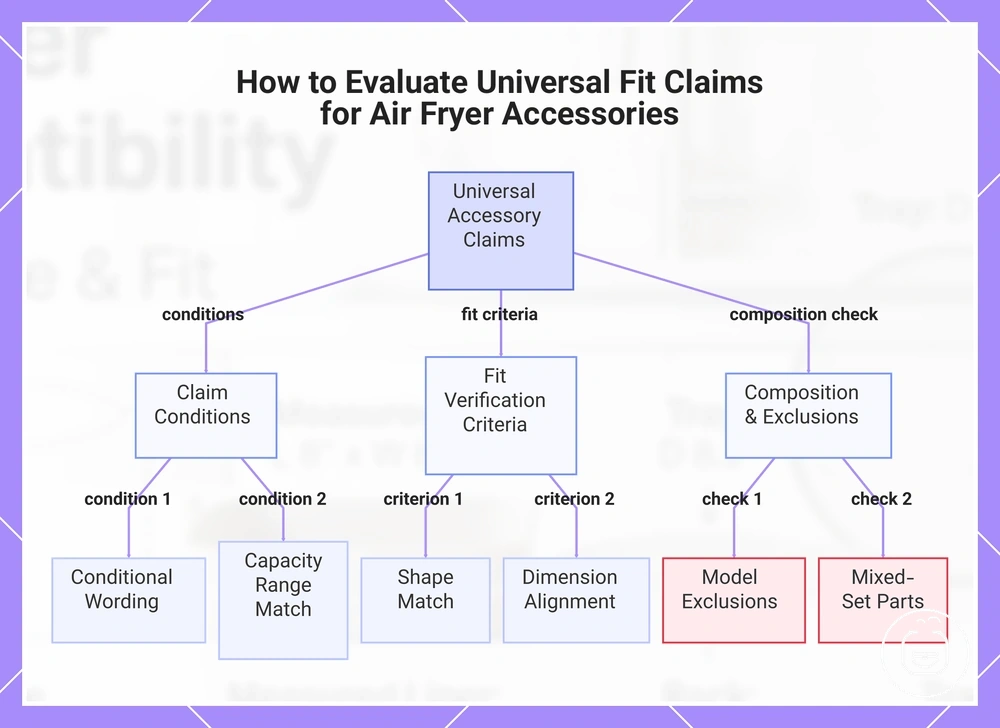
Universal accessory claims depend on how well stated compatibility aligns with model-specific compatibility, basket measurements, and accessory dimensions. A universal fit claim only holds practical value when it can be checked against capacity range, shape match, and model exclusions, since air fryer baskets vary in internal geometry and clearance across different models.
These claims should be evaluated using clear criteria that separate wording from verifiable fit conditions:
- Claim wording: “universal fit” or “compatible range” should be treated as conditional unless supported by clear specifications
- Capacity range: quart or litre range must match the air fryer size class
- Shape match: accessory geometry must align with basket shape (round, square, or rectangular)
- Accessory dimensions: footprint, height, and diameter must align with basket measurements
- Model exclusions: specific air fryer models may be excluded despite general compatibility claims
- Accessory set composition: check whether mixed-size parts are included that may not all fit the same unit
Some accessory sets include mixed-size components where only part of the set fits a given air fryer model. This creates partial compatibility, so checking accessory sets for fit helps identify which components align with your basket dimensions and which may not.
Before relying on any universal claim, verify fit through model-specific compatibility checks using basket measurements, accessory dimensions, and shape match. This helps ensure decisions are based on actual constraints rather than general labeling.
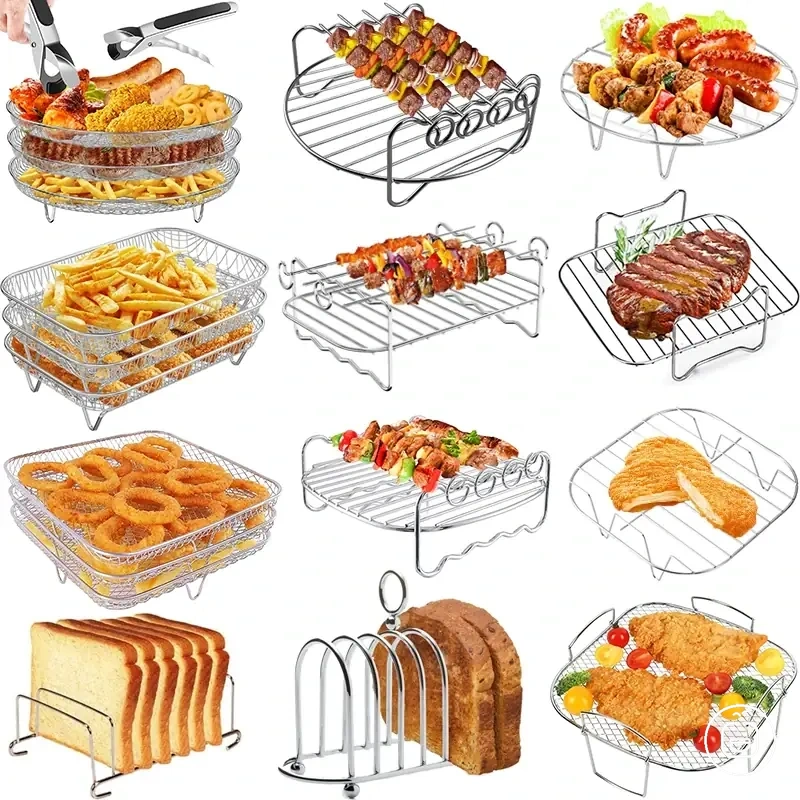
The products below are useful examples for comparing available options. Before buying, check that the compatibility criteria, key features, and product details match your needs.
This chart shows the criteria and checks needed to evaluate universal accessory claims for air fryer compatibility, helping you verify fit based on model-specific conditions.
Fit limits that affect clearance and airflow
Fit limits that affect clearance and airflow occur when an air fryer accessory is close to acceptable dimensions but still creates space constraints inside the basket. These fit problems may reduce effective clearance and airflow even when the accessory appears to match basket size, especially where tight side contact, reduced food clearance, or structural interference begins to appear during placement.
These fit limits can be identified through a symptom-based check that links observable issues to likely causes and safer adjustments:
| Symptom | Likely fit cause | Check | Safer adjustment |
|---|---|---|---|
| Tight side contact | Accessory footprint close to basket width or taper mismatch | Inspect clearance on both sides of the basket wall | Reposition for centered spacing or reduce footprint width |
| Blocked perforations | Base or liner obstructing airflow openings | Check airflow holes beneath accessory base | Realign accessory or lift slightly to restore airflow |
| Raised liners | Liner wall mismatch or edge lifting from basket shape | Inspect liner seating along full perimeter | Flatten or adjust liner fit to reduce edge lift |
| Unstable racks | Uneven contact or incompatible rack height | Test rack stability on flat basket base | Reposition or use a height-compatible rack |
| Reduced food clearance | Stack height exceeding usable vertical space | Measure remaining vertical clearance above load | Reduce stacking height or layered accessories |
| Handle interference | Handle extension into basket wall or rim space | Check handle swing and side clearance | Rotate accessory or use lower-profile handle design |
Some fit limits may result from measurement mismatch between accessory dimensions and basket size, while others may come from usage setup such as placement angle, stacking configuration, or liner positioning. These differences mean airflow restriction or clearance loss is not always a fixed defect but may depend on how the accessory is positioned inside the basket.