Types of Air Fryer Accessories by Function
Air fryer accessory types are function-based add-ons used inside the basket to support cooking, containment, airflow, surface contact, cleanup, and handling. Each accessory type plays a different role depending on how it interacts with food and circulating air inside the basket, and these functional differences determine how they are used in practice. In this context, function is the main organizing logic behind all air fryer accessories.
The usefulness of air fryer accessories often varies based on basket size, basket shape, food structure, and how airflow moves around the food during cooking. Cleanup needs and residue behavior also influence which accessory type becomes more relevant in a given cooking situation. Because of these variations, accessory types are better understood through their functional role rather than as fixed or interchangeable items.
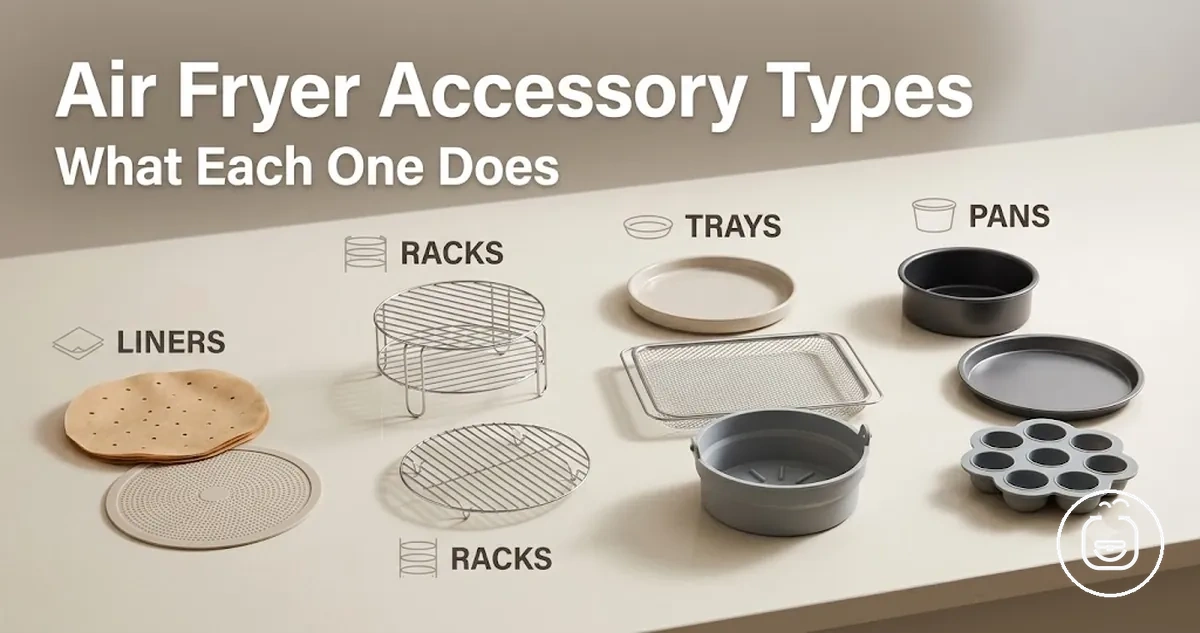
Air fryer accessories fall into functional groups such as liners, racks, trays, pans, molds, silicone mats, and cleaning tools. Each group supports a different interaction inside the basket, such as separating food from residue, elevating food for airflow, containing liquids or shaped foods, or simplifying post-cooking cleanup. These roles can overlap depending on basket loading and food type.
Accessory type selection can also vary with fit conditions, material behavior, and how the accessory interacts with heat and airflow in different air fryer designs. These factors influence whether a specific function is effective in practice, especially when food load, basket clearance, and surface coverage change during use.
Air fryer accessory types are easier to understand when grouped by function and basket behavior.
| Accessory family | Main function | Condition to check | Typical effect |
|---|---|---|---|
| Liners | Separate food from residue and support cleanup | Perforation and basket coverage | Can reduce direct residue contact in the basket |
| Racks | Elevate food to support airflow circulation | Basket clearance and food thickness | May improve exposure to circulating air |
| Trays and pans | Contain liquids, batters, or structured portions | Depth and surface design | Helps keep shaped or liquid foods stable during cooking |
| Molds | Shape food into defined forms during heating | Food type and cavity shape | Supports structured portions and controlled shaping |
| Silicone mats | Provide reusable surface separation and protection | Heat-safe material and basket fit | Can reduce sticking and simplify cleanup |
| Cleaning tools | Remove grease and residue after cooking | Material compatibility and bristle type | Helps maintain basket and accessory cleanliness |
Air fryer accessories as function-based basket add-ons
Air fryer accessories are add-ons used inside or around the basket to support cooking, spacing, containment, protection, and cleanup. They function as supporting tools that interact directly with airflow and food placement inside the basket, shaping how heat circulates and how surfaces respond during cooking. The core role of these accessories is cooking support through controlled spacing, containment, protection, and cleanup inside the basket.
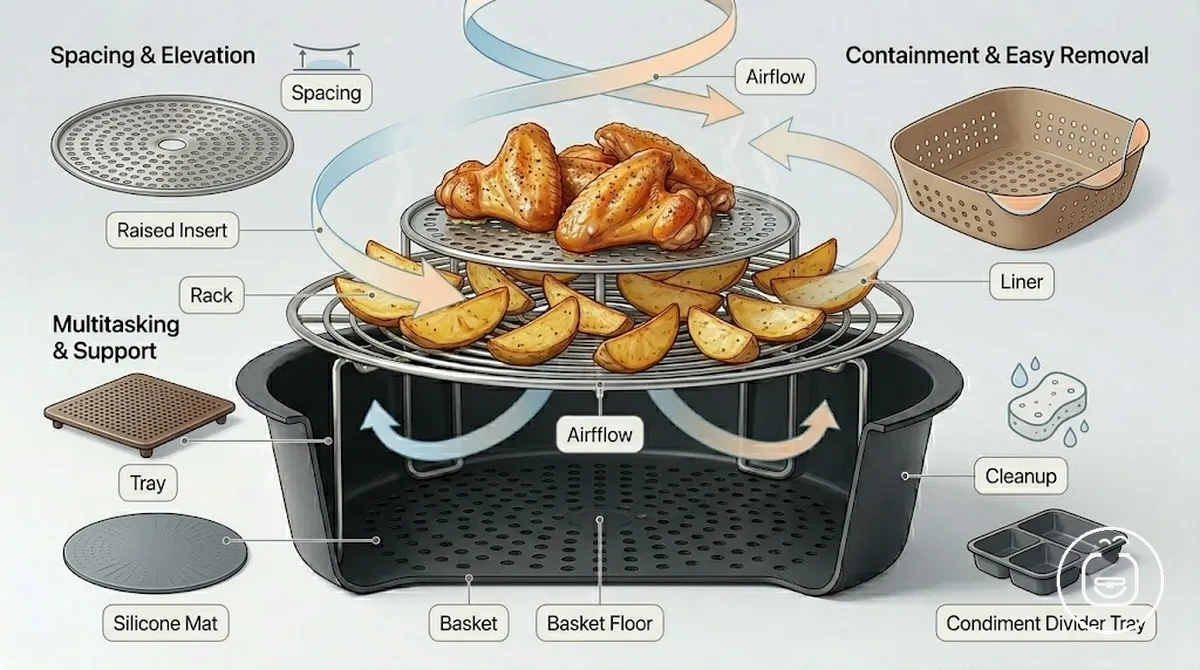
These air fryer accessories typically group into functional roles based on how they affect the basket environment. Spacing tools influence airflow around food to support more even exposure, while containment-focused pieces help manage liquids or structured foods inside the basket. Liners and silicone-based inserts relate to cleanup and residue separation, while racks, trays, and pans adjust surface structure and elevation for cooking support under different loading conditions.
This page focuses on air fryer accessories as function-based basket add-ons, and a broader overview is available in the air fryer accessories guide. Accessories support cooking conditions but do not replace correct basket loading, heat-safe material use, or airflow-aware placement inside the appliance.
:contentReference[oaicite:0]{index=0}
Attributes that separate accessory types
Accessory types are distinguished by attributes that define how they interact with the air fryer basket, including contact surface, airflow behavior, reusability, and cleanup function. These attributes separate one accessory type from another by shaping how each supports cooking inside the basket rather than changing the cooking process itself.
The main differentiating attributes include contact surface with food, airflow behavior around the basket, structural format, and cleanup function after use. Contact surface influences how food touches or stays separated from residue, while airflow behavior affects spacing and heat circulation inside the basket. Reusability determines how often an accessory is used or replaced, and cleanup function reflects how residue is managed after cooking. Together, these attributes define containment, spacing, and basket coverage behavior.
Attributes that separate accessory types depend on role, contact surface, airflow behavior, reusability, and cleanup function, and these factors are best understood visually rather than in isolation. The image below organizes these attribute groups around a central basket concept to show how each one changes function without implying ranking or preference.
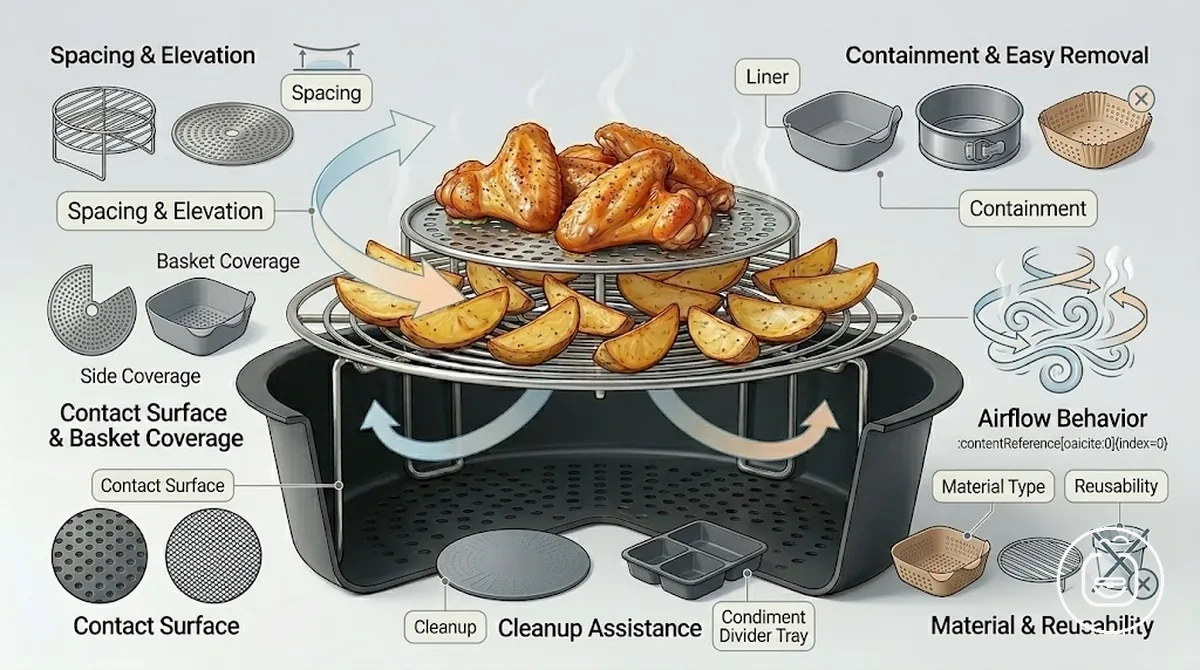
These attributes can overlap in practice, as a single accessory type may influence spacing and cleanup or combine containment with airflow support depending on basket loading and food structure.
Attributes that separate accessory types are easier to interpret when mapped into structured relationships between type, attribute, condition, and effect.
| Accessory type | Attribute that separates it | Value or condition | Practical effect |
|---|---|---|---|
| Liners | Contact surface and cleanup function | Perforation level and basket coverage | Can reduce direct residue contact in the basket |
| Racks | Airflow behavior and spacing | Elevation height and clearance | Improves air circulation around food layers |
| Trays and pans | Containment and structural format | Depth and solid base design | Supports liquid or shaped food stability |
| Molds | Containment and shaping role | Cavity structure and food fit | Helps maintain defined food shapes during cooking |
| Silicone mats | Contact surface and reusability | Heat-resistant flexible material | Reduces sticking and supports repeated use |
Food contact, containment, and cleanup role
Food contact, containment, and cleanup role describes how accessories like liner, pan, tray, and mold interact with food inside the air fryer basket by either touching food, holding it in shape, or catching residue during cooking. These roles separate accessory behavior based on food contact and residue handling rather than cooking method changes.
Food moisture, crumbs, and shape influence how these roles behave inside the basket. Moist or loose food increases residue spread and cleanup load, while structured or contained food tends to stay within defined shapes during cooking. The differences become clearer when comparing how liners, pans, trays, and molds manage food contact and containment under these conditions.
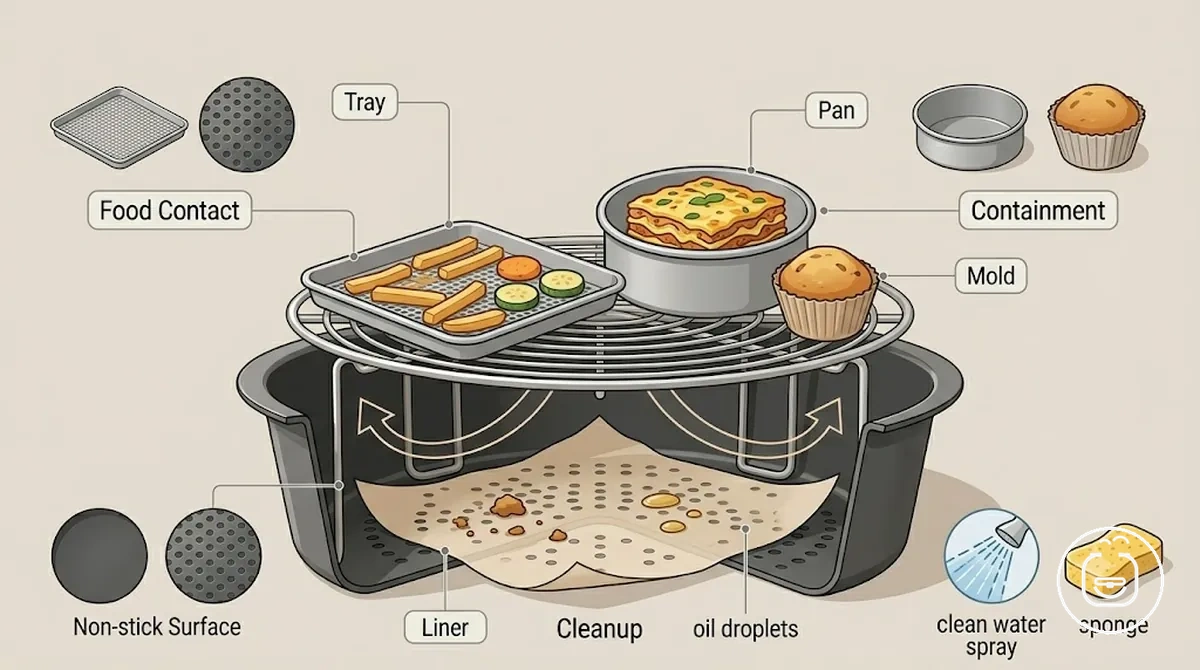
Liners mainly handle food contact by catching residue and crumbs, pans and trays focus on containment for batter or structured foods, and molds help maintain shape during cooking. Each role can influence cleanup effort depending on how much moisture or residue is produced during use.
Elevation, airflow, and cooking surface role
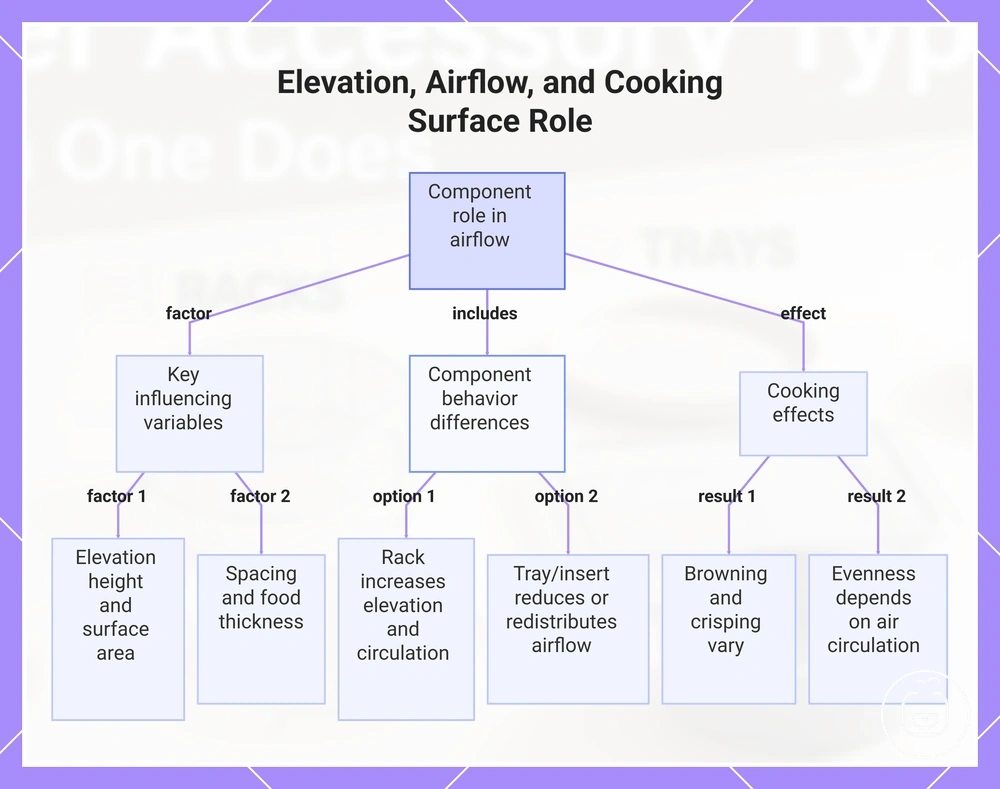
Elevation, airflow, and cooking surface role refers to how rack, tray, and insert components change exposure to circulating hot air by adjusting how food is raised, spread, or supported inside the air fryer basket. These elements influence how much of the cooking surface is directly exposed to airflow pathways and how heat moves around the food. The primary outcome is airflow exposure, which varies by elevation and surface structure.
Airflow behavior depends on elevation height, cooking surface area, spacing, and food thickness inside the basket. A rack may increase elevation to improve circulation beneath food, while a tray or insert may reduce or redistribute airflow depending on surface coverage and perforation. Effects on browning, crisping, and overall cooking evenness vary with spacing conditions, loading density, and how freely air can circulate around the cooking surface.
This chart shows how rack, tray, and insert components influence airflow exposure and cooking results by adjusting elevation and surface structure.
Reusable or disposable accessory format
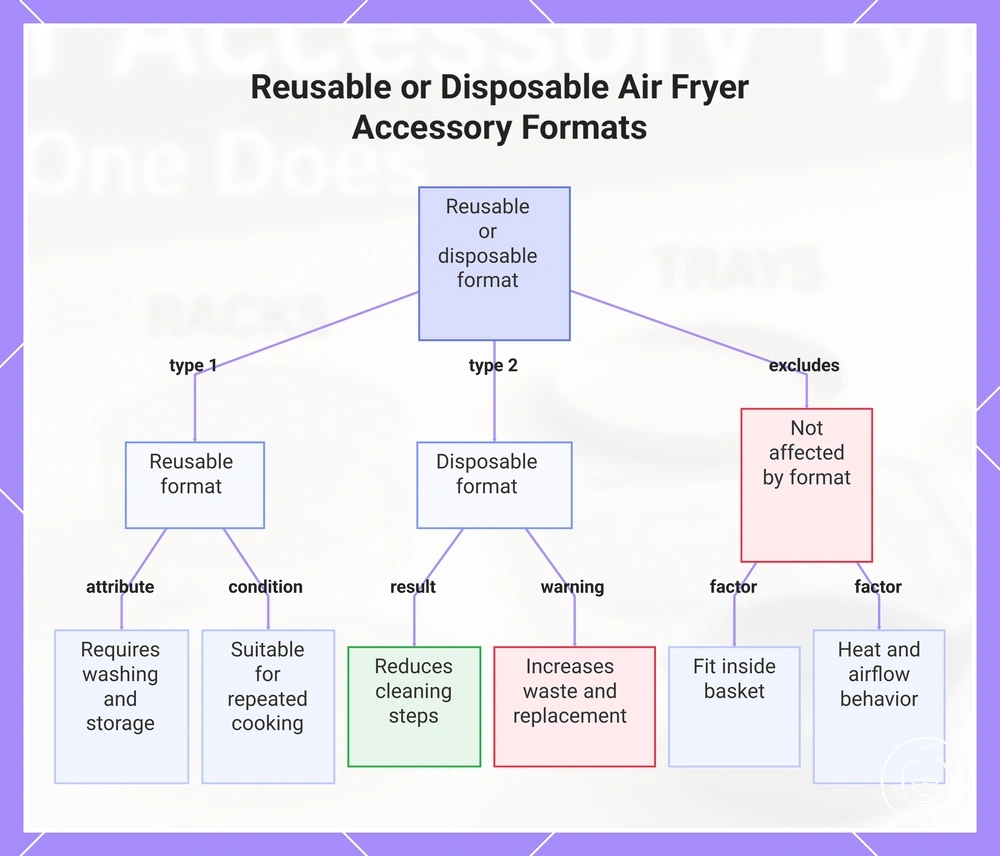
Reusable or disposable accessory format refers to whether a liner, mat, pan, or similar accessory is designed for repeated cleaning and use or for single-use replacement inside the air fryer basket. This format affects cleaning effort, storage needs, and replacement frequency, while remaining separate from the accessory’s cooking function and airflow behavior. :contentReference[oaicite:0]{index=0}
Reusable formats usually require washing and storage after each use, and they may suit repeated cooking with the same liner, mat, or pan depending on residue, moisture, and food type. Disposable formats are replaced after use, which can reduce cleaning steps but increases material waste and ongoing replacement frequency depending on how often cooking occurs and how much residue is produced.
Format choice mainly changes cleanup and handling workflow, but it does not determine fit inside the basket, heat behavior, or airflow performance by itself, since those depend on accessory design, spacing, and material structure rather than reuse type.
This chart explains the meaning of reusable and disposable accessory formats for air fryers, their key characteristics, and what they do not affect.
Accessory type versus fit, material, and necessity
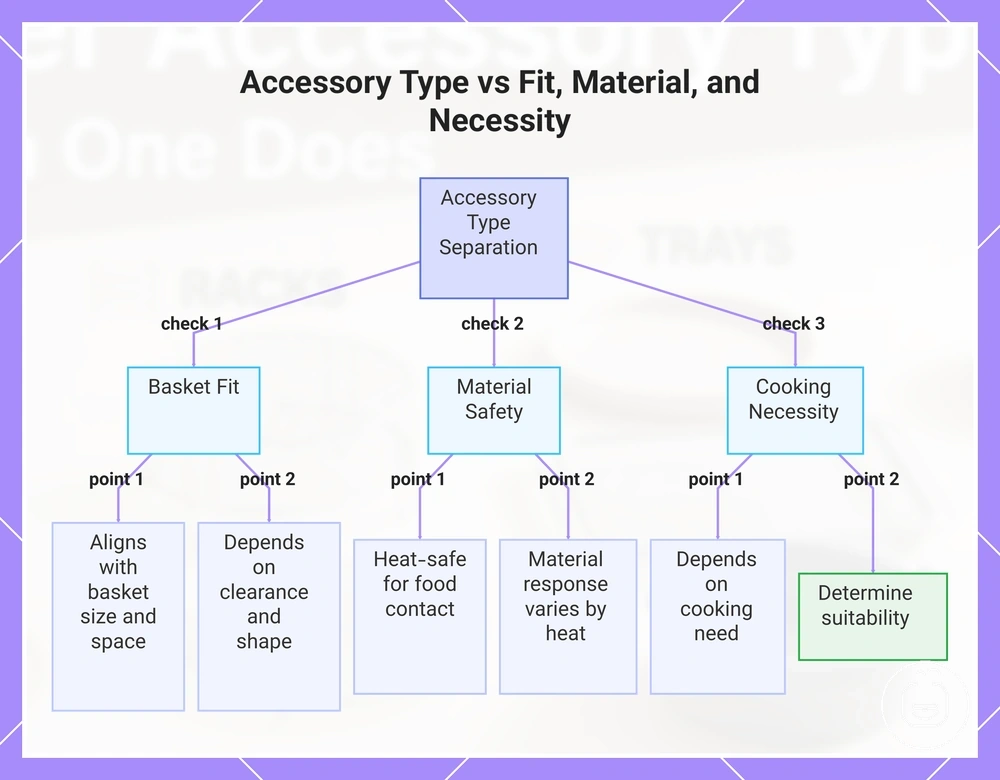
Accessory type versus fit, material, and necessity refers to separating what an accessory is from whether it fits the basket, uses heat-safe material, or is actually necessary for a specific cooking need. Accessory type identification only describes the category, while fit, material, and necessity are decision checks that depend on conditions inside the cooking setup. This separation helps avoid assuming that a known accessory type is automatically suitable or required.
Fit focuses on whether an accessory type aligns with basket size and available space. Even when an accessory type is correctly identified, usability can vary depending on clearance, spacing, and basket shape conditions, so fit must be verified separately from type.
Material evaluates whether the accessory is heat-safe and appropriate for food contact under cooking conditions. Different materials may respond differently to heat exposure, so material suitability is always a separate check from accessory type recognition.
Necessity depends on the cooking need rather than the accessory type itself. For example, accessories by cooking need helps match accessories to specific preparation requirements, since not every type is required for every cooking situation.
Accessory type alone should not be treated as a complete decision factor. In many cases, bundles such as air fryer accessory sets include multiple items that still require individual evaluation for fit, material, and necessity based on actual usage conditions.
- Accessory type vs fit: check basket size and spacing conditions
- Accessory type vs material: verify heat-safe and food contact suitability
- Accessory type vs necessity: confirm cooking need before deciding use
- Decision outcome: determine whether the accessory is suitable, useful, or unnecessary
This chart explains why accessory type alone is not sufficient and shows the three separate checks—fit, material, and necessity—that determine suitability.
Liners and silicone mats for basket protection
Liners and silicone mats for basket protection refer to accessories used to reduce direct food contact with the air fryer basket while supporting cleanup through residue control. Their function depends on perforation, coverage, airflow behavior, and food contact conditions, which means their effect is shaped by how fully the basket surface is covered and how air moves around the food. These accessories focus on basket protection and cleanup support rather than acting as universal cooking upgrades.
Liners, such as paper-based inserts, typically act as disposable basket protection layers that catch residue and reduce sticking depending on perforation and food weight. Silicone mats function as reusable inserts that provide broader surface coverage while still allowing varying airflow through designed openings or structure. In both cases, residue buildup, sticking behavior, and cleanup effort may change depending on coverage level and basket design conditions.
Before comparing types, it helps to group liner and mat behavior by protection role and surface condition.
| Liner or mat type | Main role | Condition to check | Possible effect |
|---|---|---|---|
| Liners (paper-type) | Catch residue and support basket protection | Perforation and basket coverage | May reduce direct food contact and residue buildup |
| Silicone mats | Reusable basket protection and cleanup support | Coverage level and airflow openings | May influence airflow and sticking depending on design |
air fryer liners compared helps clarify how reusable and disposable options differ in usage behavior, while this section focuses on liners and silicone mats as basket protection and cleanup-support accessories based on type function.
Paper and parchment liners
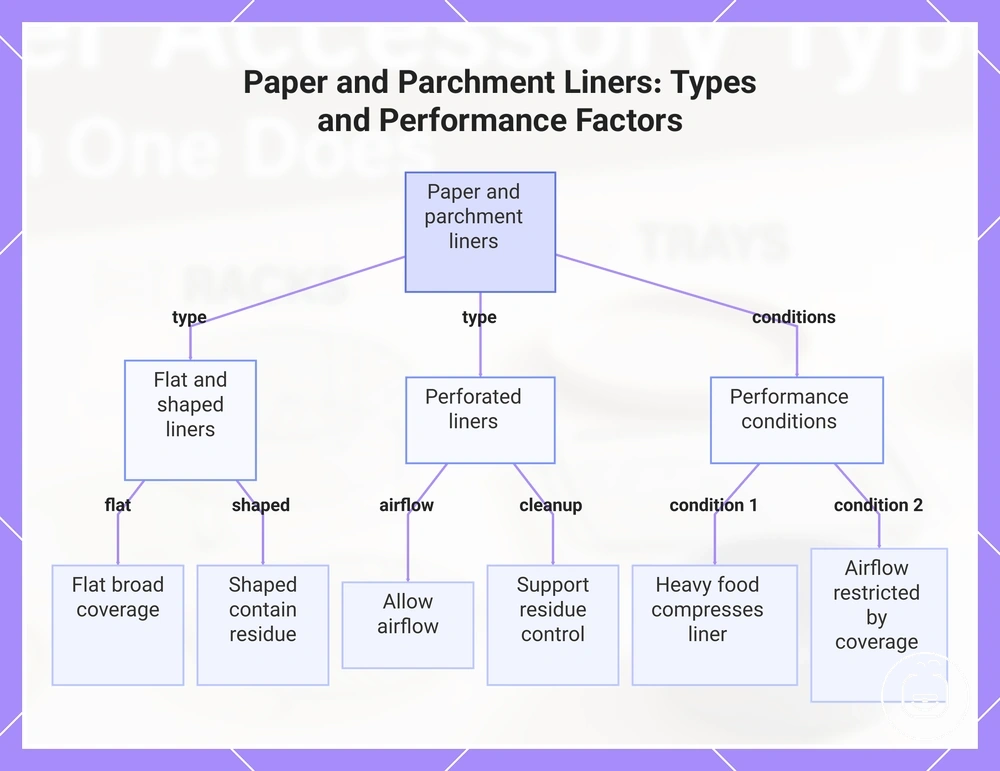
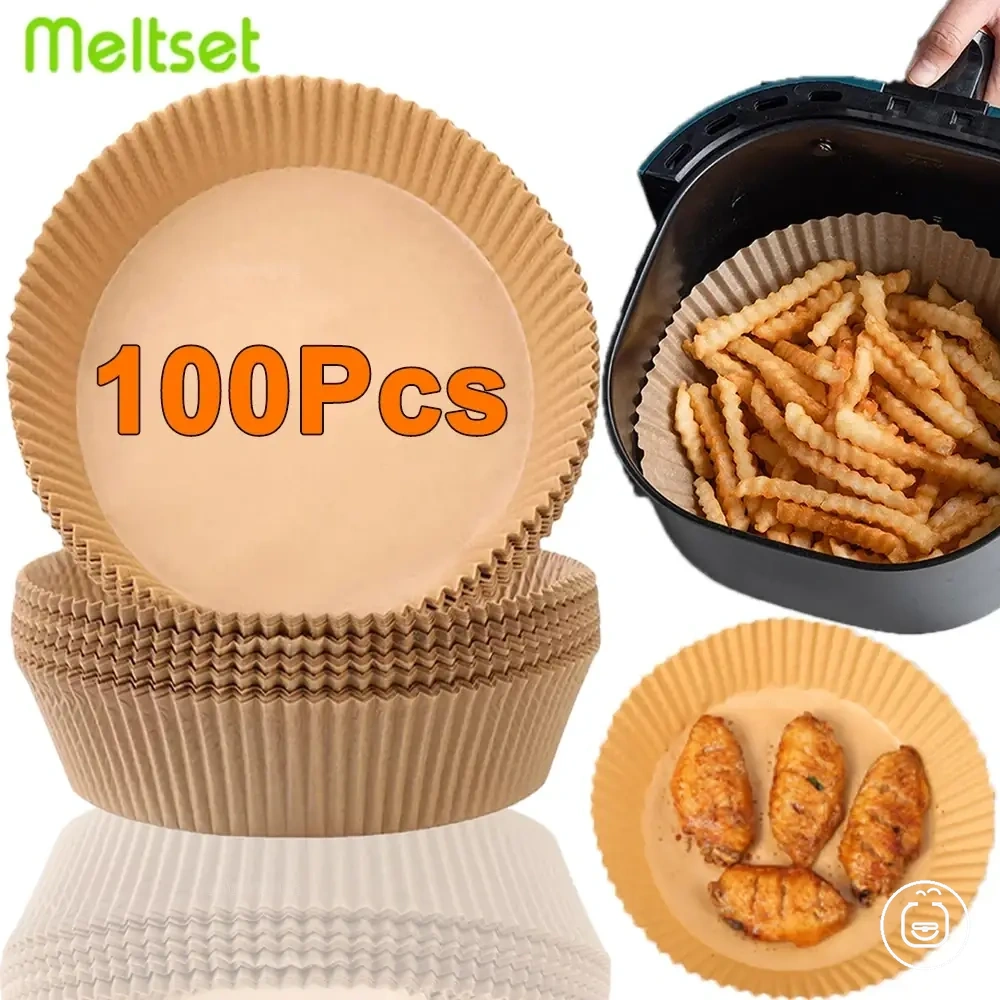
Paper liners and parchment liners are disposable inserts used inside the air fryer basket to support residue control and easier cleanup by creating a temporary separation layer between food and the basket surface. These paper liners and parchment liners line the basket, catch residue, and reduce direct food contact, with their cleanup role depending on perforation, coverage, and food weight conditions during cooking.
Paper and parchment liners depend on shape, perforation, flatness, food weight, and airflow conditions, which influence how they sit in the basket and how residue is collected during use. Performance varies when heavier food compresses the liner or when airflow is restricted by full coverage.
- Flat liners: provide broad coverage and may increase residue collection depending on food weight and basket airflow
- Shaped liners: follow basket form and help contain residue in defined areas during cooking
- Perforated liners: allow airflow through openings while still supporting residue control and cleanup
Paper and parchment liners remain disposable inserts mainly used for residue management and cleanup support, with their behavior depending on basket design, perforation level, and food load conditions.
This chart shows the main liner designs and the conditions that affect residue control and cleanup in an air fryer.
Silicone liners and mats
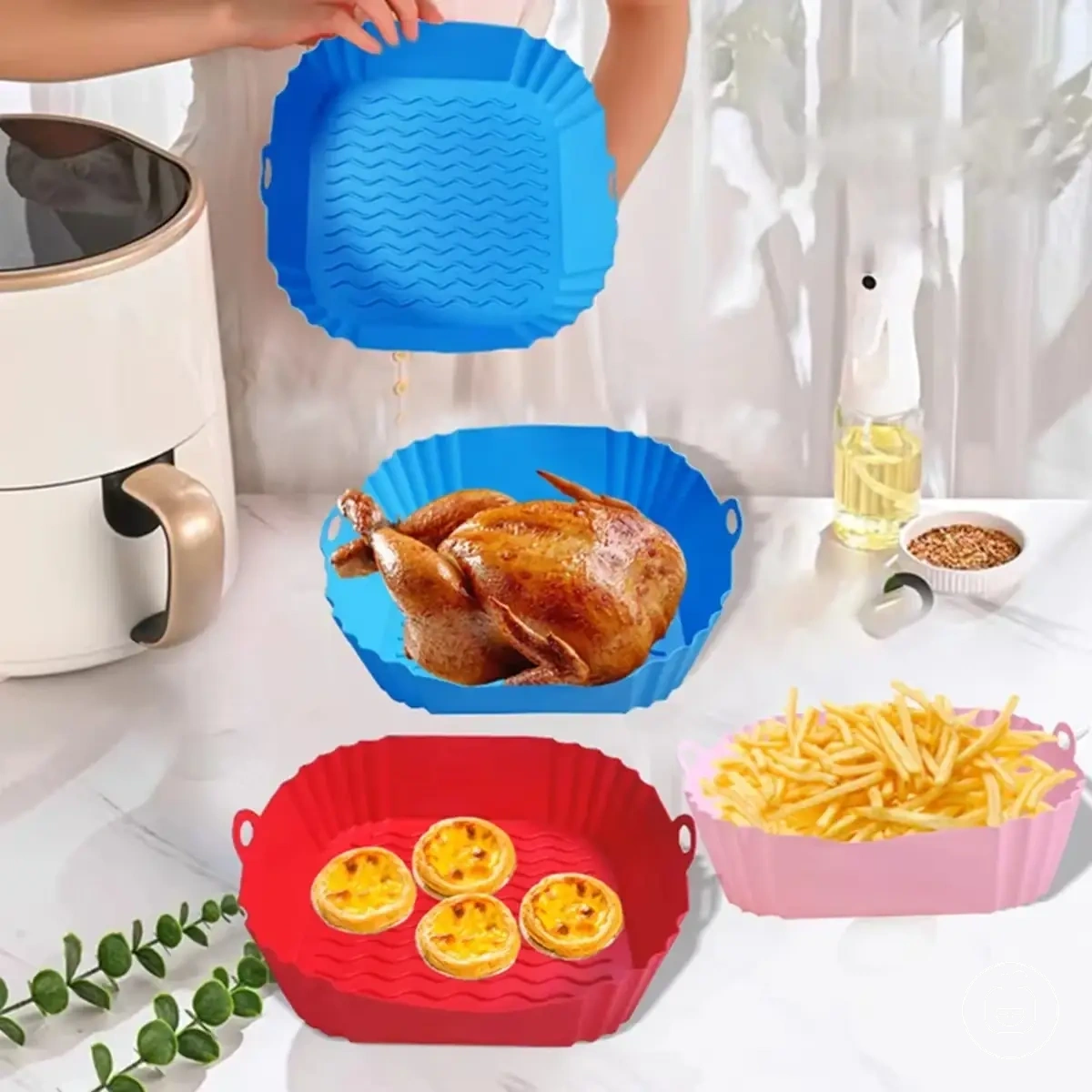
Silicone liners and silicone mats are reusable inserts used inside the air fryer basket to support containment, cleanup, and surface separation during cooking. Silicone liners and silicone mats depend on their form and structure to flex, fit, and separate food from the basket surface, with behavior influenced by depth, ribbing, perforation, flexibility, and basket fit. These reusable inserts mainly support residue handling and controlled cleanup rather than changing the core cooking process.
Silicone liners typically provide deeper containment that can hold food juices or crumbs, while silicone mats are usually flatter surfaces that support food placement with varying airflow depending on perforation and surface design. Ribbing and perforation patterns can influence how airflow moves around food, while flexibility affects how easily the insert fits different basket shapes and how it is removed after use.
Silicone liners and silicone mats depend on heat-safe material conditions, basket fit, and manufacturer guidance, since suitability may vary based on food load, airflow behavior, and appliance design.
:contentReference[oaicite:0]{index=0}
Racks and skewer holders for elevation and spacing
Racks and skewer holders are elevation and spacing accessories used inside an air fryer basket to raise food, separate layers, and control airflow paths during cooking. They affect airflow, basket clearance, layering, browning, and turning behavior by changing how food is positioned vertically, with elevation and spacing as the primary functional role. :contentReference[oaicite:0]{index=0}
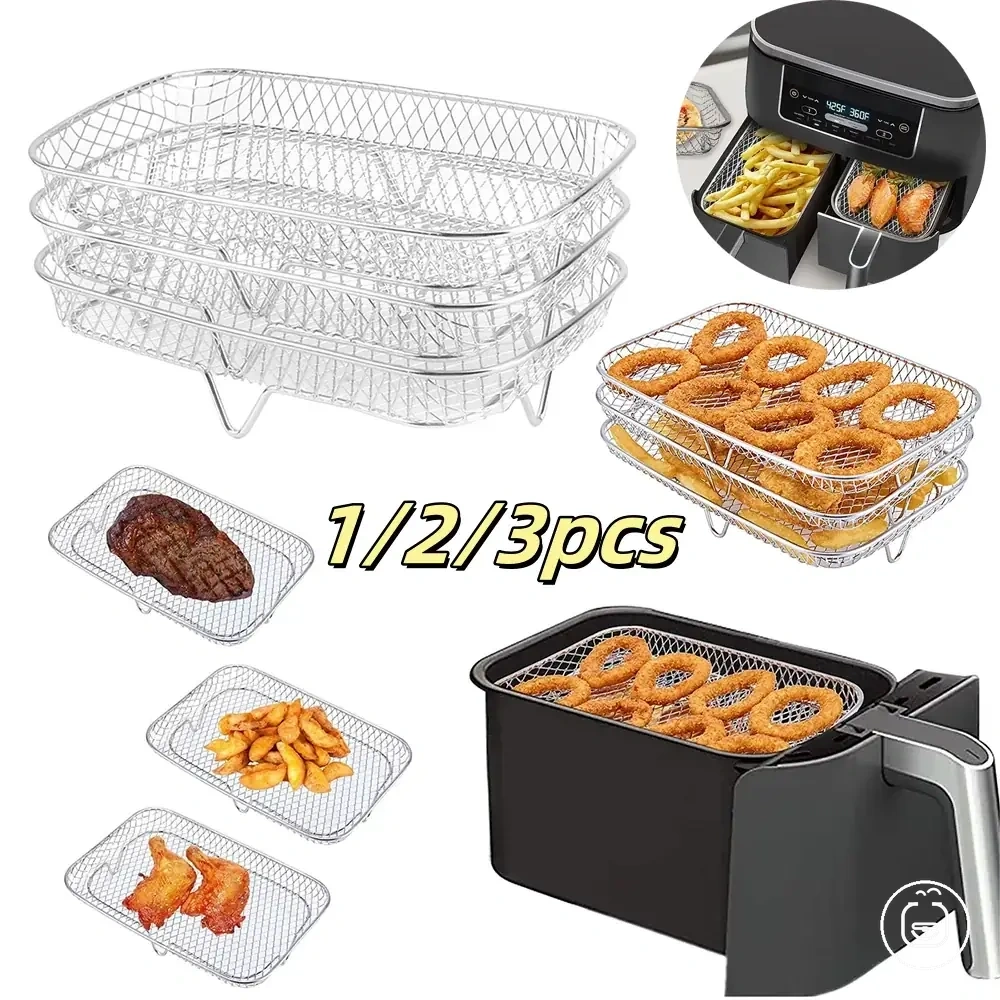
Racks function as raised structures that create additional levels inside the basket, allowing food to sit above the base surface. This elevation changes airflow exposure around flat or stacked foods, where basket clearance and food thickness influence how evenly browning develops and how stable layered placement remains during cooking.
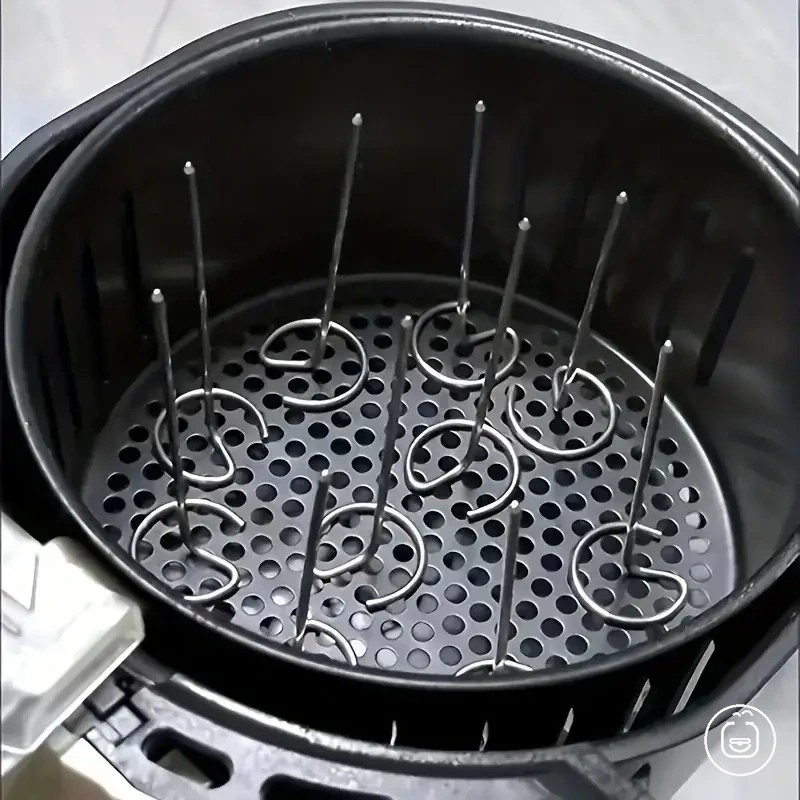
Skewer holders support skewered items by holding and spacing small food pieces so they remain separated during cooking. This spacing affects airflow reach on multiple sides of skewered food, while turning and positioning depend on item size, load density, and available basket clearance.
Flat foods, skewered pieces, and layered items require different spacing logic because they interact differently with elevation and airflow paths. Flat foods depend more on rack clearance, skewered items rely on consistent spacing for turning, and layered foods are more sensitive to stacking height and airflow restriction. using different air fryer accessories helps understand how spacing conditions affect practical use.
| Accessory | Elevation or spacing role | Condition to check | Likely effect |
|---|---|---|---|
| Rack | Creates elevated layers for stacking | Basket clearance and food thickness | May influence airflow exposure and browning consistency depending on layering |
| Skewer holder | Spaces and suspends skewered food | Item size and spacing between pieces | Supports multi-side airflow and turning behavior depending on load density |
Cooking racks
Cooking racks are raised surfaces used inside an air fryer basket to create spacing above the base or form an additional cooking layer. Cooking racks support separation between food items by adjusting elevation and exposure within the basket, resulting in raised spacing within the basket. :contentReference[oaicite:0]{index=0}
Cooking racks vary by height, tier count, and openness, and these attributes determine how basket clearance and food thickness interact with airflow and handling conditions. Higher height increases elevation while requiring sufficient basket clearance, and openness affects how freely airflow can move around food during cooking. Based on structure, cooking racks can be grouped as:
- Single-level racks: provide one raised surface for moderate elevation where basket clearance and food thickness limit stacking and airflow exposure
- Multi-level racks: create multiple tiers that adjust spacing between layers, where airflow, browning, and handling depend on tier count and vertical clearance
Skewer racks and holders
Skewer racks and holders are accessories used inside an air fryer basket to suspend and organize small food pieces on skewers for controlled spacing and turning support. Skewer racks and holders support small food pieces by holding skewers in position, creating suspension and spacing that affects exposure and movement during cooking.
Skewer racks and holders depend on skewer placement, small food piece size, and basket clearance, since these conditions influence how securely items are held and how freely they can turn. Holder design can affect suspension stability, while clearance determines whether skewers can rotate or remain fixed depending on basket space and loading conditions.
Before use, it helps to consider how spacing and handling change based on structure and food size.
- Spacing: organizes small food pieces along skewers to maintain separation between items
- Basket clearance: determines whether skewers can be properly suspended and rotated inside the basket
- Handling: affects how easily skewers can be turned or repositioned during cooking based on holder design
Skewer racks and holders mainly support organization and exposure of small food pieces, while performance depends on clearance, spacing, and how the skewers are supported within the basket structure.
Trays, pans, and molds for contained cooking
Trays, pans, and molds are contained-cooking accessories used to hold liquids, batter, shaped foods, crumbs, or small portions inside an air fryer basket during cooking. These trays, pans, and molds define how food is contained and stabilized under heat exposure, with containment as the central function.
Contained cooking depends on depth, shape, surface, and heat exposure, since these factors determine how trays, pans, and molds manage batter, crumbs, and shaped foods. Deeper forms increase retention of liquids, while flatter surfaces allow more spread and collection of loose particles depending on food behavior.
Before comparing forms, it helps to understand how structure affects contained cooking performance.
| Accessory form | Containment attribute | Food condition | Practical effect |
|---|---|---|---|
| Tray | Shallow surface containment | Crumbs and spreadable portions | Supports collection of loose particles and easier cleanup |
| Pan | Deep containment structure | Batter and liquid-based mixtures | Helps stabilize flow under heat exposure |
| Mold | Shape-defined cavity containment | Shaped foods and portions | Helps maintain structure and controlled removal |
Surface behavior and heat exposure influence how trays, pans, and molds affect texture and handling, since open surfaces may allow more direct heat interaction while deeper forms can limit spread and support structured results depending on food type.
Trays, pans, and molds are selected based on whether foods spread, drip, crumble, or require a defined shape, where trays manage loose crumbs, pans support batter-based mixtures, and molds maintain portion structure with controlled form retention.
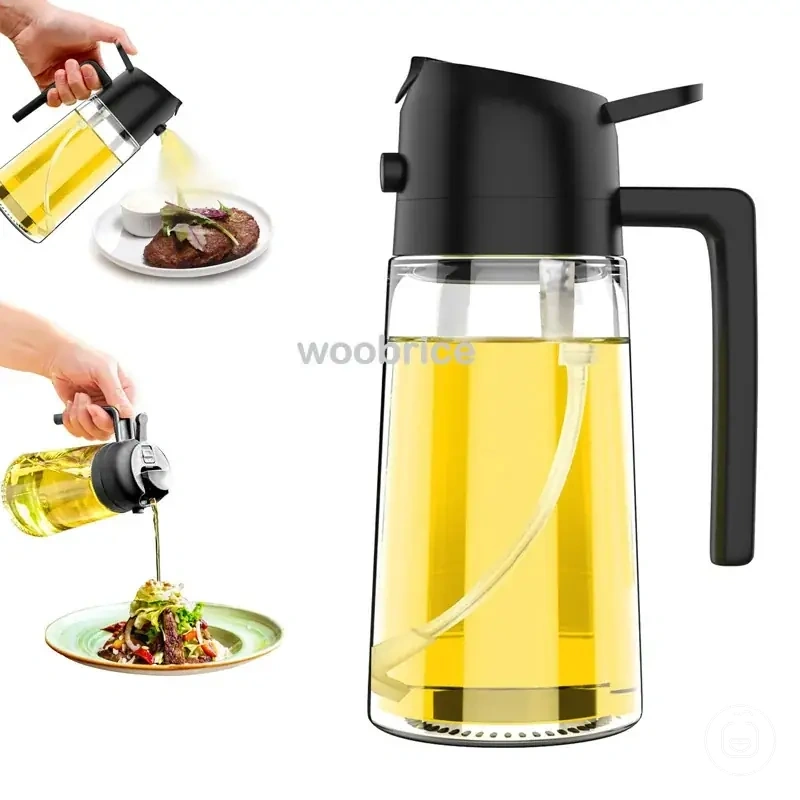
Here are product examples that may make comparison easier. Before buying, always review the compatibility criteria, essential features, and product details.
Crisper trays and basket inserts
Crisper trays and basket inserts are crisper tray surfaces placed inside the air fryer basket to adjust contact area and support separation between food and residue during cooking. These basket inserts sit within the basket to change how food touches the base surface, influencing residue separation and grease movement under heat exposure, where contact area and residue separation remain the primary effects.
Crisper trays and basket inserts depend on perforation, ridges, and raised surface structure, which affect how grease drainage and airflow interaction occur around food. Increased perforation typically supports better residue separation, while ridges and raised surfaces modify food contact points, which may influence crisping behavior depending on food size, load distribution, and appliance design conditions.
Baking pans, cake pans, and pizza pans
Baking pans, cake pans, and pizza pans are shaped cooking containers or flat baking surfaces used to support foods that need structure during heating. These baking pan, cake pan, and pizza pan forms manage how batter, dough, and portioned foods hold shape under heat exposure, with containment and browning behavior depending on their design and depth. :contentReference[oaicite:0]{index=0}
Baking pans, cake pans, and pizza pans differ mainly by depth, diameter, and surface structure, which influence how batter and dough behave during cooking. A baking pan typically supports general containment for mixed portions, a cake pan relies on deeper walls for batter stability, while a pizza pan uses a flatter surface that exposes dough more directly to heat, affecting browning and surface development depending on food form and load conditions.
To compare how each pan form relates to structure and food behavior, the main differences can be summarized as follows.
| Pan form | Shape or depth | Food form | Effect |
|---|---|---|---|
| Baking pan | Moderate depth and broad diameter | Batter and mixed portions | Supports general containment and even heat exposure |
| Cake pan | Deeper structure with defined sides | Batter-based mixtures | Helps maintain containment during rising and setting |
| Pizza pan | Flat surface with wide diameter | Dough-based foods | Increases surface exposure affecting browning behavior |
Egg molds and small portion molds
Egg mold and small portion mold are shaping accessories used to form foods into cavity-based, divided portions inside the air fryer basket. These egg mold and small portion mold tools create structured cavities that hold ingredients in defined shapes during heating, supporting portioning through cavity formation and controlled shape setting that results in divided portions and structured shape.
Egg mold and small portion mold behavior depends on cavity count, depth, flexibility, and removal conditions, which influence how food sets and releases after heating.
Before using these molds, key attributes include:
- Cavity count: determines how many divided portions can be formed in a single mold
- Depth: affects how much mixture is held and how strongly shape is formed during setting
- Flexibility: influences how easily food can be released during removal after setting
Cleaning tools as maintenance-support accessories
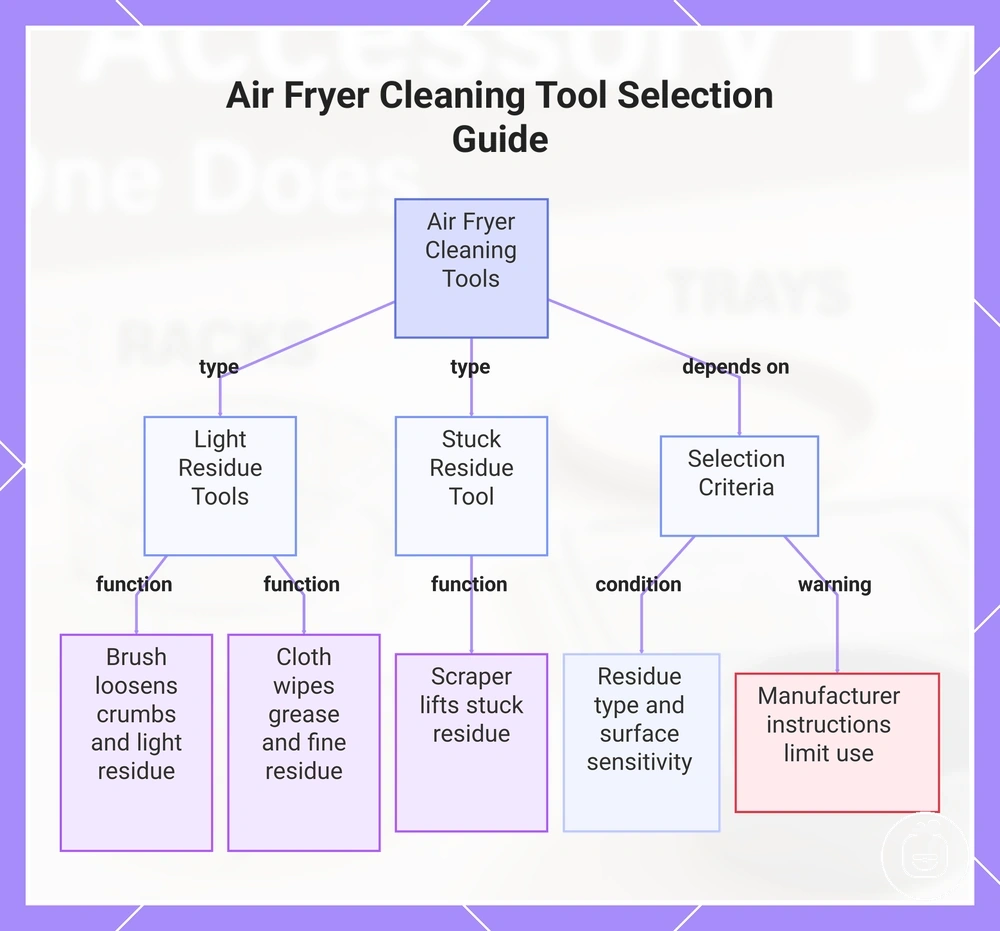
Cleaning tools are maintenance-support accessories used after cooking to maintain air fryer baskets, racks, trays, pans, and liners by helping manage grease, crumbs, and residue buildup. Cleaning tools such as a cleaning brush, scraper, and cloth support maintenance by loosening and removing leftover particles without changing the function of the cooking accessories. :contentReference[oaicite:0]{index=0}
Cleaning tools selection depends on residue type, surface sensitivity, and accessory material. Grease, crumbs, and stuck residue behave differently on coated and uncoated surfaces, so the choice of cleaning brush, scraper, or cloth must align with surface sensitivity and nonstick care conditions to reduce wear risk during maintenance.
Cleaning tools can be grouped based on how they interact with residue and surface conditions. A short maintenance check helps match tool type to cleaning need:
- Cleaning brush: helps loosen crumbs and light residue, suitable for surfaces with moderate sensitivity during maintenance
- Cloth: helps wipe grease and fine residue from smoother surfaces while supporting nonstick care conditions
- Scraper: helps lift stuck residue where surface sensitivity must be carefully considered to avoid surface wear
Cleaning tools support maintenance of cooking accessories, but they do not override manufacturer cleaning instructions or material limits, and their effectiveness depends on grease level, residue type, and surface sensitivity conditions.
This chart helps choose the right cleaning tool for air fryer accessories based on residue type and surface conditions.