Air Fryer Accessory Sets vs Individual Accessories for Better Value
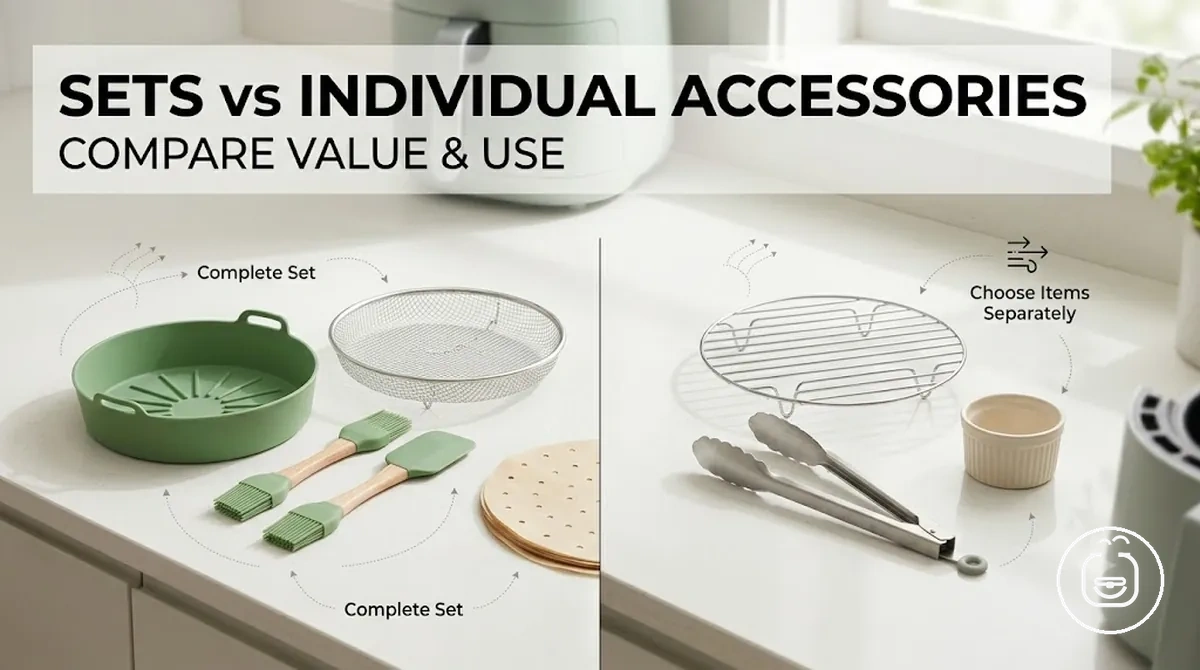
Value comparison between an air fryer accessory set and individual accessories depends on fit, usable pieces, and cooking needs. A set can deliver stronger value when most included items match your cooking habits and basket size, while individual accessories are often more efficient when you only need one or two precise tools. The decision depends on how well the pieces align with real use rather than how many items are included.
Value varies significantly based on cooking patterns, basket size, and how often different functions like baking, grilling, or cleanup are needed. An accessory kit may feel more complete for users who cook in varied ways and can use multiple items regularly. However, the number of pieces in a bundle does not always translate into practical value, especially when only a few items are actually used.
In many cases, duplicate items and low-use pieces reduce the overall usefulness of an air fryer accessory set. Compatibility differences with basket shape, clearance, and material claims can also affect whether all included accessories are usable. When these factors are unclear, individual accessories can reduce waste and improve precision by focusing only on what is needed.
This page compares both buying routes to clarify when each option supports better value. The focus remains on usability, compatibility, and real cooking needs rather than the total number of accessories included in a bundle.
What air fryer accessory sets usually include
An air fryer accessory set is a grouped accessory kit that combines included pieces designed to support cooking function tasks such as baking, layering, crisping, and cleanup. For a broader context of related tools, the air fryer accessories hub helps position how these kits fit within the wider accessory ecosystem. Contents vary by kit, so the exact combination of items depends on design and intended use.
What air fryer accessory sets usually include can be understood as a mix of functional parts organized around cooking and cleanup needs rather than fixed product lists. The image below shows common components and how they relate to usage roles, while the table clarifies what accessory sets include in functional terms.
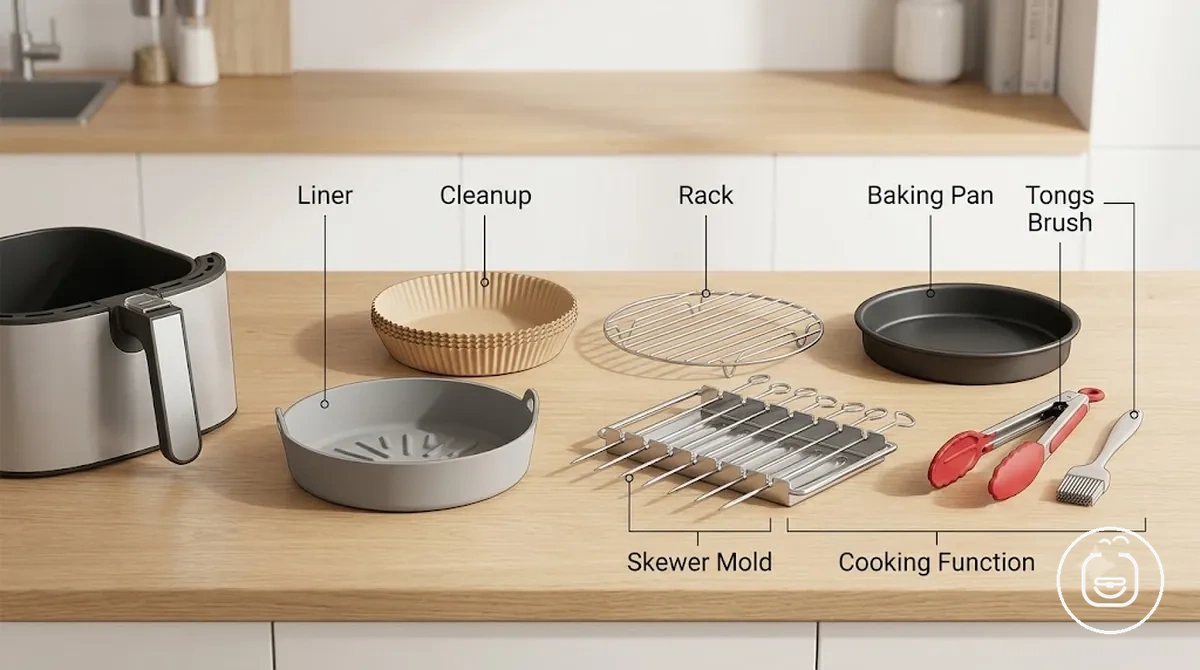
| Included piece | Common function | Value signal | Fit or use caution |
|---|---|---|---|
| Liner | Cleanup and airflow protection | Useful for reducing residue buildup | Must match basket size and airflow space |
| Rack | Layering and crisping support | Improves multi-level cooking efficiency | Height must match basket clearance |
| Pan | Baking and structured cooking | Supports batter-based or soft foods | Fit depends on basket shape and coating |
| Skewer or mold | Portion shaping and structured cooking | Useful for specific recipe formats | May not align with all basket designs |
| Tongs or cleaning brush | Handling and maintenance support | Improves safe handling and cleaning | Durability varies by material quality |
Not every included piece in an air fryer accessory set delivers the same level of practical use across all cooking needs. Items like liners, racks, and pans often align with frequent cooking and cleanup functions, while skewers or molds depend more on specific recipes. This variation means value depends on how well included pieces match actual cooking needs rather than assuming uniform usefulness across the entire accessory kit. Broader accessory types outside a standard set may extend functionality further depending on usage patterns.
Common kit pieces and cooking functions
Common kit pieces in an air fryer accessory set matter because each item should directly support a cooking function or cleanup function during regular use. These pieces can be understood by how they map to specific cooking function or cleanup function roles inside the basket, as shown in the image below.
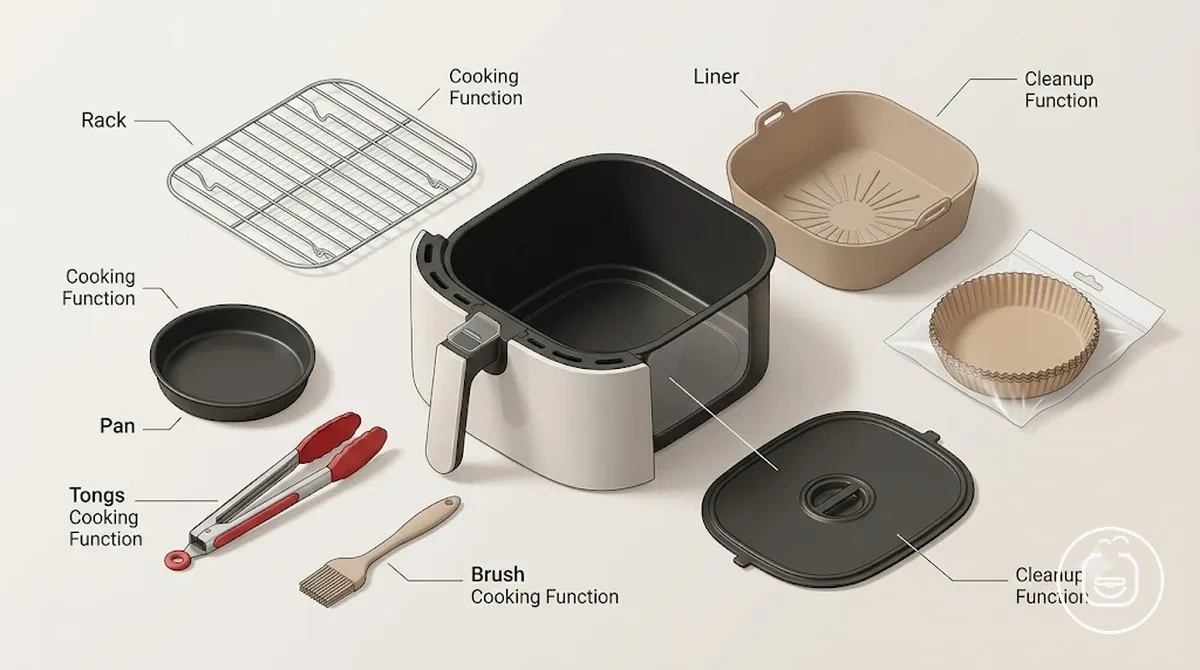
Each useful piece in a kit contributes differently depending on how it supports cooking tasks, basket space, and cleanup effort rather than acting as a uniform add-on.
- Liner supports cleanup function by reducing residue in the basket, but may affect airflow depending on placement.
- Rack supports layering and crisping by improving airflow space, with usefulness depending on basket height.
- Pan supports baking cooking function for batter-based foods, but requires fit alignment with basket size.
- Skewer supports structured cooking function for small food pieces, but usefulness depends on recipe type.
- Mold supports shaping cooking function for specific food formats, but may have limited everyday use.
- Tongs support handling during cooking and improve safety when managing hot items inside the basket.
- Brush supports cleanup function by helping remove grease and buildup during maintenance.
- Mat supports surface protection and cleanup function, but may influence airflow depending on design.
Baking, rack and pan set variations
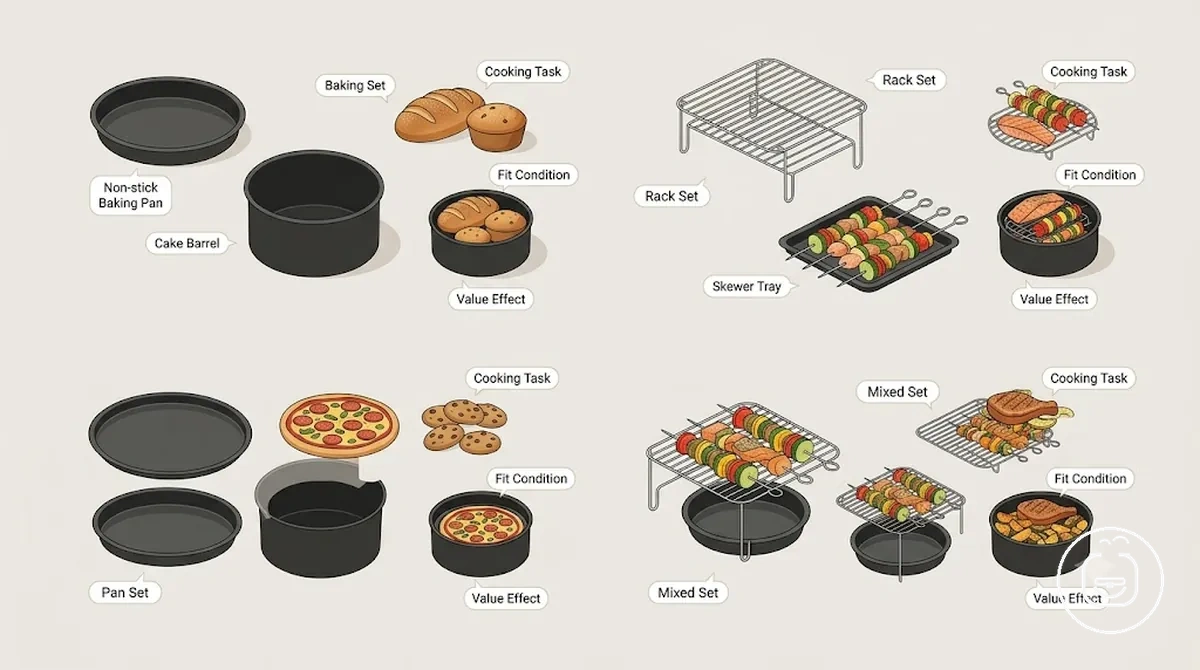
Baking, rack and pan set variations refer to different accessory set configurations inside an air fryer accessory set that focus on specific cooking tasks such as baking, layering, and structured cooking. These variations include baking set, rack set, pan set, and mixed rack-and-pan set options, and each should be evaluated based on the cooking task it supports and the fit condition inside the basket.
These variations change how an air fryer accessory set performs depending on whether the priority is baking volume, airflow layering, or structured tray cooking. Baking, rack and pan set variations can be better understood by comparing how each type affects cooking task efficiency, fit condition, and overall value effect inside the basket. The image below shows how these set types differ in structure and use.
| Set variation | Common pieces | Best-fit task | Value caution |
|---|---|---|---|
| Baking set | Baking pan, cake barrel, muffin cup | Batter-based cooking tasks | May be redundant if baking trays already exist |
| Rack set | Rack, skewer rack, crisper tray | Layering and airflow crisping | Value depends on basket height and airflow space |
| Pan set | Pizza pan, cake barrel, baking pan | Structured single-layer cooking tasks | Fit condition critical for basket compatibility |
| Mixed rack-and-pan set | Rack, pan, crisper tray | Multi-task cooking flexibility | Higher redundancy risk if partial pieces are unused |
How set value changes versus buying individual accessories
Set value depends on usable pieces rather than piece count alone. A set value increases only when included usable pieces match real cooking needs with fit confidence, use frequency alignment, and acceptable material quality. Individual accessories shift value toward precision because each item is selected based on exact need and controlled use frequency rather than bundled inclusion.
The main issue with bundle price evaluation is that piece count can include duplicate items or low-use components that do not improve overall utility. This increases waste risk when overlap exists between included tools and what is already available. Fit confidence also becomes inconsistent when some pieces do not align with basket compatibility or cooking task requirements. The comparison below highlights how buying route decisions affect usable pieces, durability expectations, and overlap-driven value gain or loss.
| Buying route | Value advantage | Main risk | Better when |
|---|---|---|---|
| Accessory set | Broader coverage of cooking tasks at a single bundle price | Duplicate items reduce usable pieces and increase waste risk | When starting from scratch and multiple cooking tasks are needed |
| Individual accessory | Higher fit confidence and control over material quality and use frequency | Higher cost per item and slower coverage of all needs | When replacing specific tools or improving compatibility |
| Skip or delay buying | Avoids unnecessary bundle price and overlap-driven waste | Limited immediate cooking flexibility | When existing tools already cover required cooking tasks |
For beginners, set value may increase because usable pieces cover multiple basic cooking tasks in one bundle. For frequent users, individual accessories often improve value because use frequency is concentrated on specific tools where material quality and fit confidence matter more. For replacement buyers, value depends on whether missing tools justify a full set or only targeted individual purchase.
A practical value check is to compare overlap between existing tools and included usable pieces, then evaluate whether duplicate items increase waste risk or whether individual accessories better match long-term cooking task needs.
Useful pieces versus low-use bundle fillers
A useful piece in an air fryer accessory set is defined by repeated use, clear cooking purpose, and proper fit in the basket. Low-use filler refers to items that are included mainly to increase piece count but do not consistently match cooking purpose or fit requirements. The distinction depends on how often a piece is actually used and whether it supports real cooking tasks. The checklist below helps separate useful pieces from low-use bundle fillers.
A liner, for example, may be a useful piece for users who cook frequently and deal with regular cleanup needs, while it can feel like a low-use filler for users who rarely need additional basket protection. This shows how the same accessory can shift in value depending on cooking habits and air fryer design. Judging only by piece count can therefore misrepresent actual usefulness.
- liner — repeated use in cleanup — needed when residue buildup is frequent — value outcome depends on maintenance frequency
- rack — repeated use for layering — needed when airflow stacking is part of cooking purpose — value outcome improves multi-layer cooking
- pan — repeated use for structured cooking — needed when solid base cooking is frequent — value outcome supports stable cooking setup
- mold — occasional use depending on baking habit — needed when shaping food is required — value outcome varies with basket size and usage
- skewer — repeated use for spaced cooking — needed when grilling-style cooking purpose is common — value outcome depends on cooking style frequency
- tongs — repeated use for handling — needed for safe removal during cooking — value outcome improves safety and control
- brush — repeated use for cleaning — needed for post-cooking maintenance — value outcome supports upkeep efficiency
Bundle savings versus unused or duplicate items
Bundle savings depend on usable items rather than the listed set price, and value decreases when unused items or duplicate items increase inside the bundle. A usable-piece count that matches real cooking purpose improves bundle value, while value risk increases when overlap reduces practical benefit. In many cases, duplicate items weaken savings even when the bundle price appears lower at first glance. :contentReference[oaicite:0]{index=0}
Unused items and poor fit conditions reduce expected use frequency, which lowers the real benefit of bundle savings over time. When replacement need is low because existing tools already cover similar functions, extra items mainly add storage load instead of practical value. This is why bundle evaluation should focus on usable pieces rather than total included items. :contentReference[oaicite:1]{index=1}
Cost per usable piece can be used as a cautious decision signal, but it should not be treated as a fixed rule because usage patterns and fit conditions vary by user. A bundle may still offer value when usable items align with repeated cooking needs, even if some pieces remain unused. :contentReference[oaicite:2]{index=2}
- usable-piece count — improves bundle savings when items match cooking purpose and expected use frequency
- duplicate items — reduce value when overlapping with existing tools and increasing storage waste risk
- unused items — weaken bundle savings when they do not support regular cooking tasks or fit requirements
- replacement need — increases value when the bundle fills missing tools instead of redundant ones
Compatibility checks that affect accessory set value
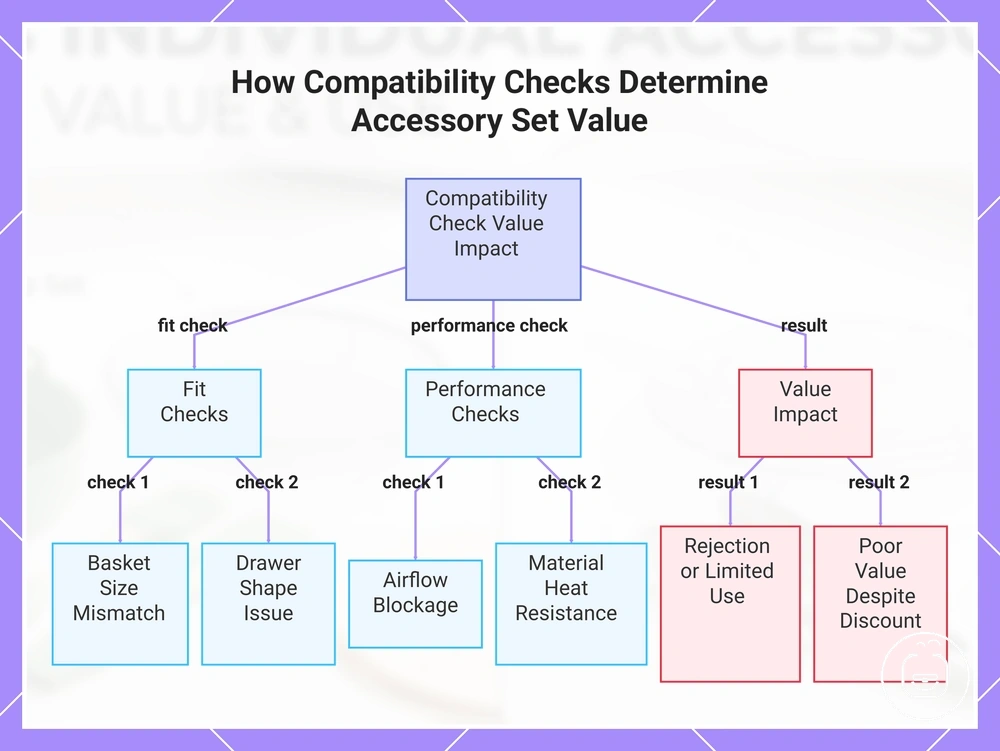
Compatibility directly affects accessory set value because even a discounted set has weak value if the main pieces do not fit or cannot be used safely in the target air fryer. A usable set depends on correct compatibility between accessories and the air fryer system, and this relationship determines final value impact more than bundle size or price.
Compatibility checks usually focus on basket size, drawer shape, quart range, clearance, airflow behavior, material type, coating stability, and dishwasher-safe claim alignment. These factors determine whether accessories can be placed safely, maintain heat exposure stability, and remain usable during cooking. When these checks fail, accessories may need rejection or limited use, which reduces overall set value. The checklist below summarizes the key verification points.
A discounted set can still have poor value when key pieces fail fit checks, even if the bundle looks complete. In such cases, the set compatibility and fit becomes the deciding factor for whether accessories deliver usable performance or remain unused. This section focuses on value impact, while detailed sizing belongs to the compatibility context.
Compatibility checklist:
- Basket size — verify internal dimensions against accessory size; mismatch leads to poor fit or unusable placement.
- Drawer shape — check round or square format; incorrect shape reduces stability and usable cooking space.
- Quart range — compare fryer capacity range with accessory volume; mismatch increases overcrowding or inefficient cooking flow.
- Clearance — measure vertical and side space; insufficient clearance restricts airflow and safe placement.
- Airflow — evaluate rack or liner design impact; blocked airflow reduces cooking performance and consistency.
- Material — check heat resistance level; weak material may deform under repeated heat exposure.
- Coating — verify non-stick durability; poor coating reduces long-term usability.
- Dishwasher-safe claim — confirm actual material tolerance; mismatch affects cleaning durability and long-term use.
This chart shows the key compatibility checks that impact accessory set value and the outcome when checks fail.
Basket size, shape and quart range
Basket size, shape and quart range determine whether the largest kit pieces can be used inside an air fryer, and inner measurements matter more than the quart label alone. Quart range is only a rough capacity signal and does not guarantee usable space for accessories. The largest pieces such as a pan or rack are the main risk point when dimensions are not verified.
Basket size, drawer shape, and clearance together decide whether a pan or rack can sit properly without blocking airflow or touching the heating area. Round and square basket formats affect how diameter, width, and usable space align with accessory shape. Handle space can also reduce usable placement even when the basket appears large enough. Fit becomes conditional based on how these measurements align with accessory dimensions.
Quart labels are not enough to confirm compatibility because they do not reflect actual inner measurements.
Sizing checklist:
- basket size (inner measurements) — check usable internal space to determine whether a pan or rack can physically fit — mismatch leads to unusable placement
- drawer shape — verify round or square basket format against accessory shape — mismatch reduces usable area and stability
- quart range — use only as a capacity signal, not a fit guarantee — mismatch possible even within same quart class
- diameter or width — measure internal cross-space for placement of pan or rack — insufficient space prevents fit pass
- height clearance — check vertical space above accessories — low clearance blocks safe placement and airflow
- handle space — confirm internal handle clearance — restricted space can prevent full insertion or proper positioning
Material, coating and dishwasher-safe claims
Material, coating and dishwasher-safe claim influence how an air fryer accessory set performs in real use, especially in terms of cleaning effort, surface wear, and long-term usability. Silicone, stainless steel, coated metal, parchment, and nonstick surfaces each create different durability signals depending on heat tolerance conditions and repeated cooking cycles. These factors directly shape how practical and maintainable a set remains over time.
Material claims and coating quality should be interpreted as usage indicators rather than fixed guarantees, since performance can vary based on cleaning effort, heat exposure conditions, and usage frequency. Dishwasher-safe claim may suggest easier cleaning, but it still depends on manufacturer instructions and actual material behavior under repeated cycles. These signals help evaluate whether accessories remain functional or degrade through surface wear over time.
- silicone — flexible material that can reduce sticking and cleaning effort, but wear may increase under repeated heat exposure conditions
- stainless steel — strong durability signal for racks and structural parts, with stable heat tolerance but variable cleaning effort depending on residue buildup
- coated metal — supports nonstick performance, but surface wear can gradually reduce coating effectiveness and usability
- parchment — reduces cleaning effort by acting as a protective layer, but offers limited long-term reuse value
- nonstick coating — improves food release and lowers cleaning effort, but durability depends on coating quality and usage conditions
- dishwasher-safe claim — indicates potential cleaning convenience, but must align with material limits and manufacturer guidance to remain valid
When an air fryer accessory set is worth buying
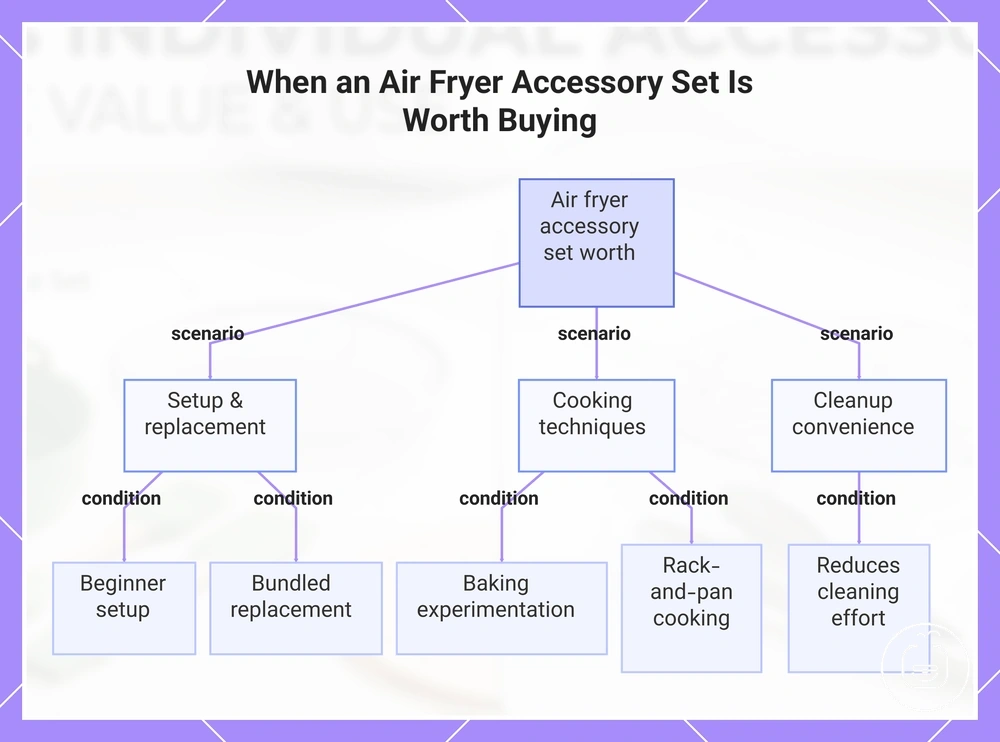
An air fryer accessory set is worth buying when several included pieces match the air fryer size, cooking habits, and near-term use cases in a practical way. This value depends on fit and repeated use rather than piece count alone. When the included pieces align with real cooking habits, the set can support quicker setup and more consistent usage patterns.
Worth buying situations depend on how the air fryer accessory set fits actual cooking habits and how often the included pieces will be used again. The value increases when multiple tools are expected to support repeated cooking tasks instead of remaining unused after initial setup.
In many cases, an air fryer accessory set is not automatically essential for every user. A selective approach using essential accessories before sets can help reduce overbuying when cooking needs are still unclear or limited.
Scenario conditions where a set may be worth buying:
- beginner setup — when starting from zero and needing multiple basic included pieces to handle early cooking tasks with minimal separate purchases
- baking experimentation — when using pan, mold, or rack-based cooking frequently for testing recipes that require structured accessories
- rack-and-pan cooking — when layered cooking or airflow-based preparation is used regularly for more complex meals
- cleanup convenience — when liners and brushes help reduce routine cleaning effort and support easier maintenance after repeated use
- bundled replacement needs — when several worn or missing accessories are replaced together instead of sourcing them individually over time
This chart shows the specific scenarios where an air fryer accessory set is worth buying, based on fit and repeated use.
When individual air fryer accessories are better value
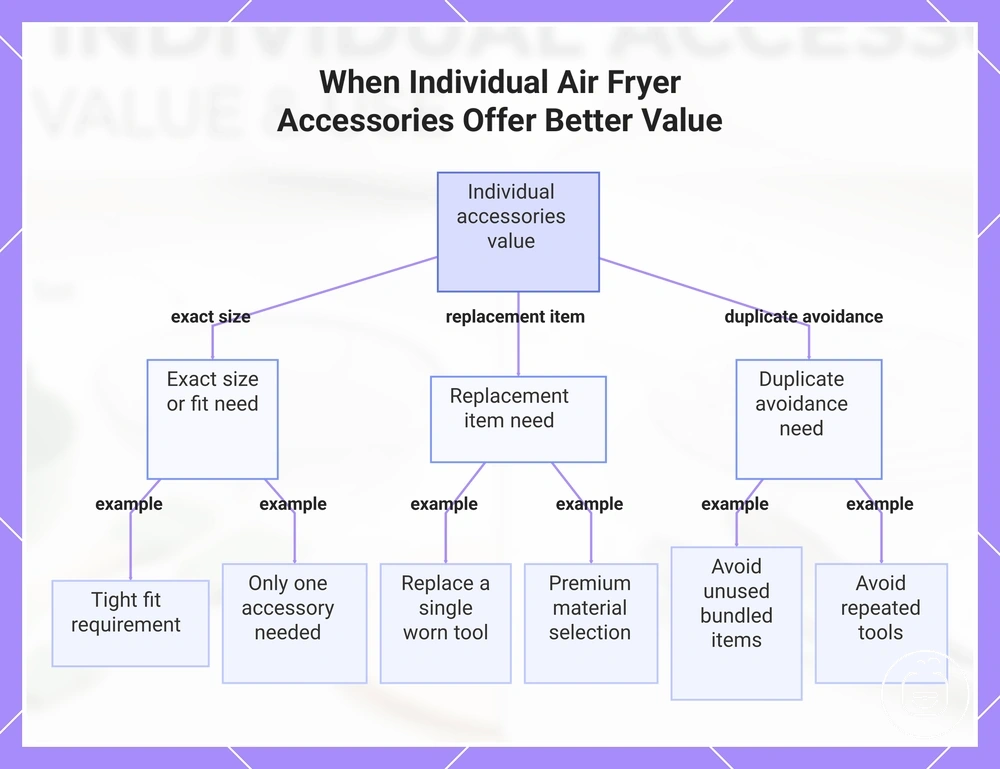
Individual accessories are better value when there is a precise need, tight fit requirement, or when only one accessory is required for repeated use. In these situations, individual accessories align directly with cooking habits and exact size needs, reducing unnecessary bundled items. This approach prioritizes precision over breadth when selecting a single accessory.
Individual accessories provide better value when exact size requirements, replacement item needs, or duplicate avoidance matter more than bundled variety. Choosing separate accessories helps avoid unused items and supports more controlled selection of premium material or durability-focused tools. It also reduces waste by limiting purchases to what is actually needed for repeated use.
In low-use cooking habits, buying one accessory can be more efficient because only a single function is required. For example, selecting one rack for airflow cooking or one liner for cleanup convenience may deliver better practical use than a broader bundle with overlapping or unused pieces.
Comparison: Individual buying vs value outcome
- clear need — individual buying works better when only one accessory is required — it improves precision and reduces unnecessary bundled items
- replacement item — individual buying works better when replacing a single worn tool — it avoids paying for unused accessories
- exact size — individual buying works better when tight fit requirements exist — it reduces mismatch risk with basket dimensions
- material preference — individual buying works better when premium material is needed for one tool — it allows focused durability selection
- duplicate avoidance — individual buying works better when avoiding repeated tools — it reduces waste and unused inventory
This chart shows the key conditions under which buying individual air fryer accessories provides better value than purchasing a bundle.
How to choose between a kit and separate accessories
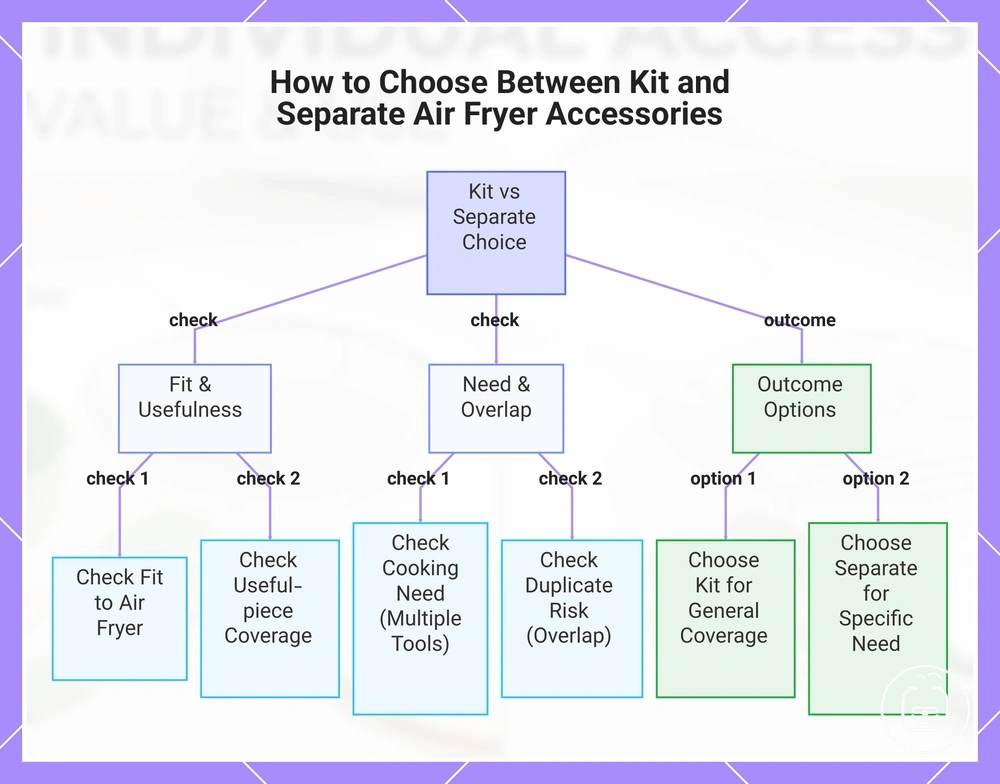
Choosing between a kit and separate accessories depends on whether useful-piece coverage or a precise need with fit, use frequency, and duplicate risk matters more. A kit option may align better when broader useful-piece coverage is required, while separate accessories often match better when a precise need defines the selection. The decision depends on fit and usefulness rather than bundle size alone.
Duplicate risk and use frequency influence the decision because unused items can increase waste and reduce practical value over time. Cleaning burden and materials also matter since kits may include more items that require maintenance without matching actual cooking need. When overlap is high, choosing separate accessories or skipping unnecessary items can reduce waste and improve control.
A kit option is typically considered when multiple tools are needed at once for general cooking coverage, while separate accessories are more suitable when a single function is required or when existing tools already cover part of the need. In some cases, skipping both options may be reasonable when there is no clear cooking need or when current tools already meet requirements without gaps.
Criteria check for final decision: The final evaluation can be guided using an accessory buying checklist to confirm fit, useful-piece coverage, materials, cleaning burden, cooking need, and overlap before choosing between a kit or separate accessories. This helps structure the decision flow before final selection.
- Fit — check whether kit or separate accessory matches air fryer dimensions and usable space
- Useful-piece coverage — evaluate whether included items will actually be used or remain unused
- Materials — assess durability and suitability for repeated cooking use
- Cleaning burden — consider maintenance effort added by multiple accessories
- Cooking need — confirm whether multiple tools are required or only one accessory is needed
- Duplicate risk — identify overlap with existing tools to avoid waste
- Decision outcome — choose kit, separate accessories, or skip based on criteria
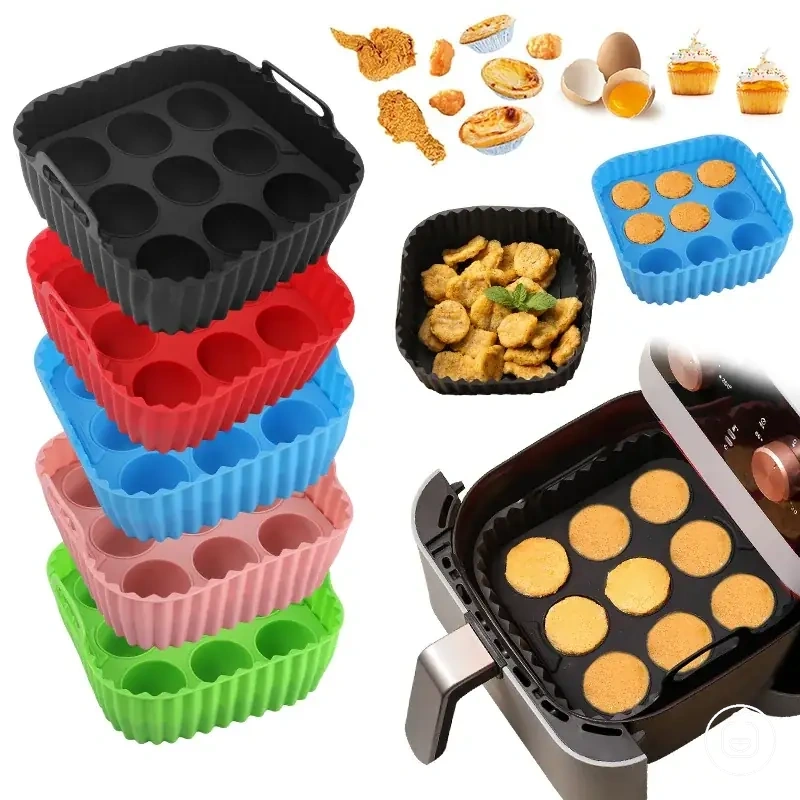
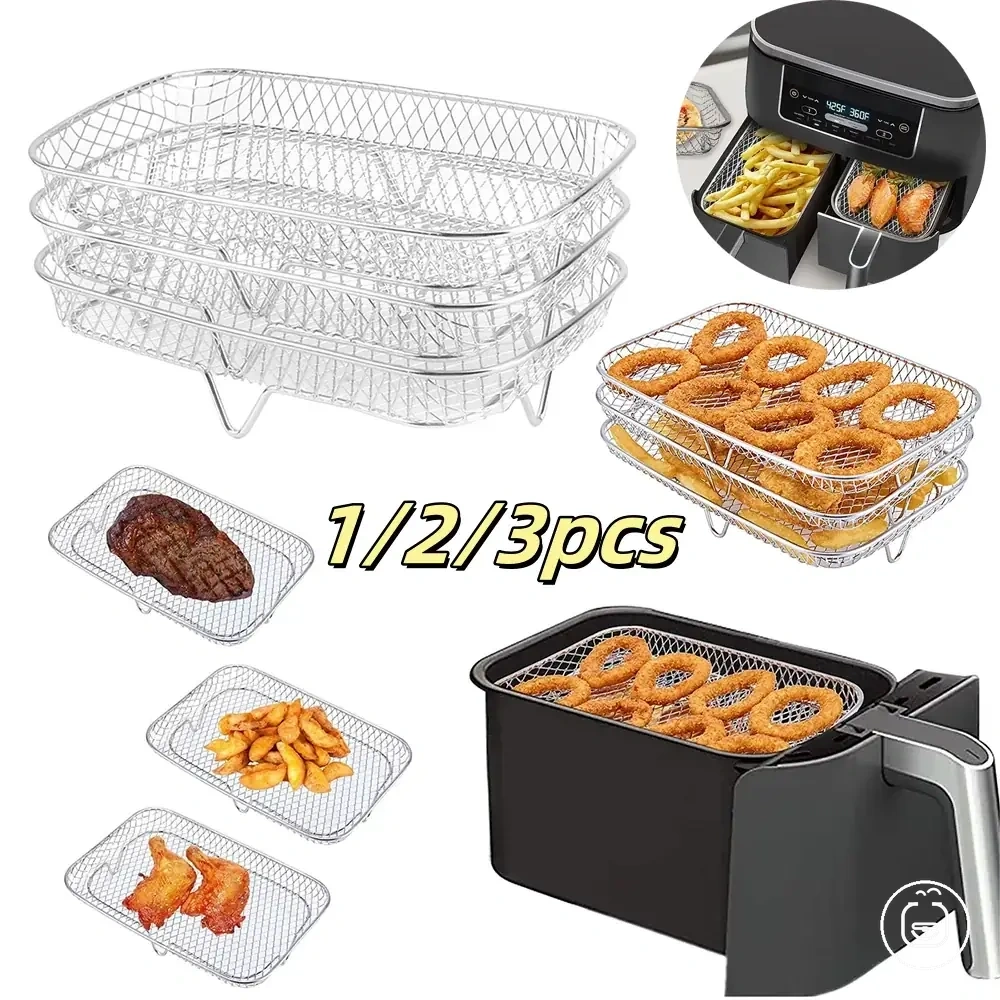
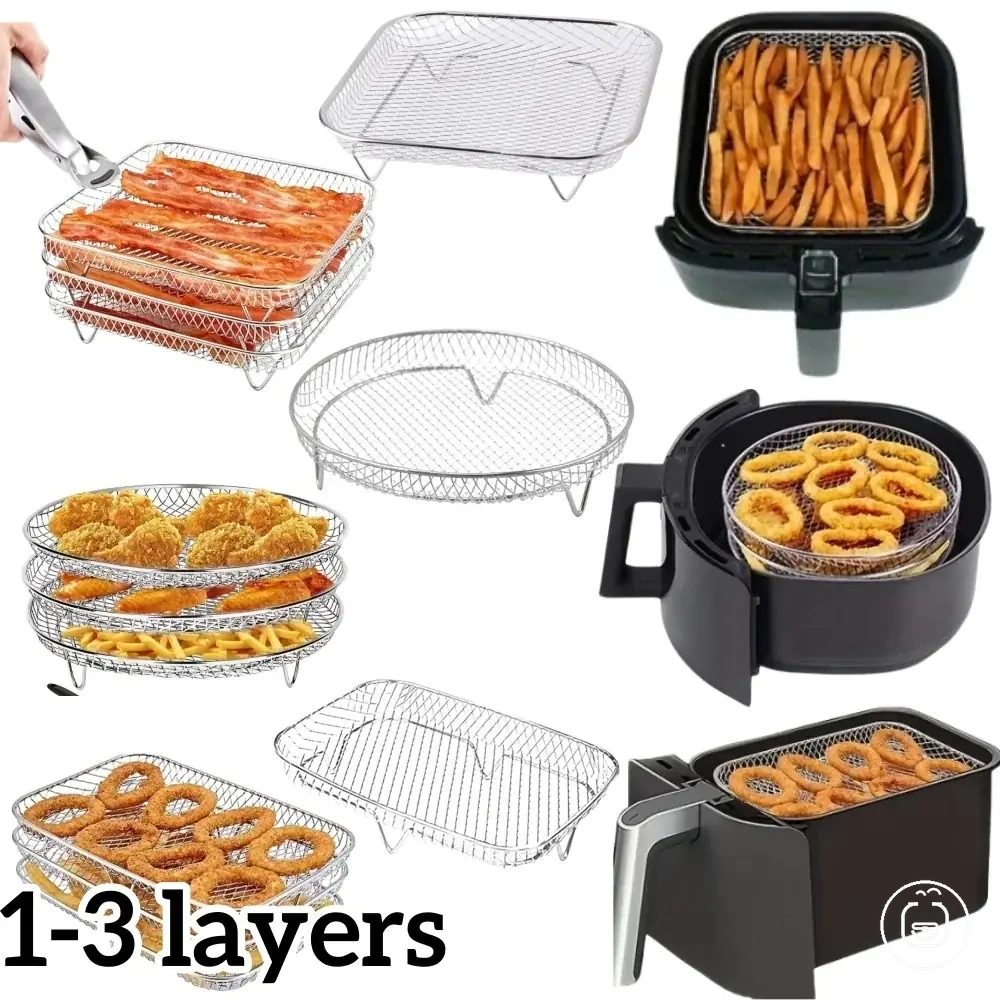
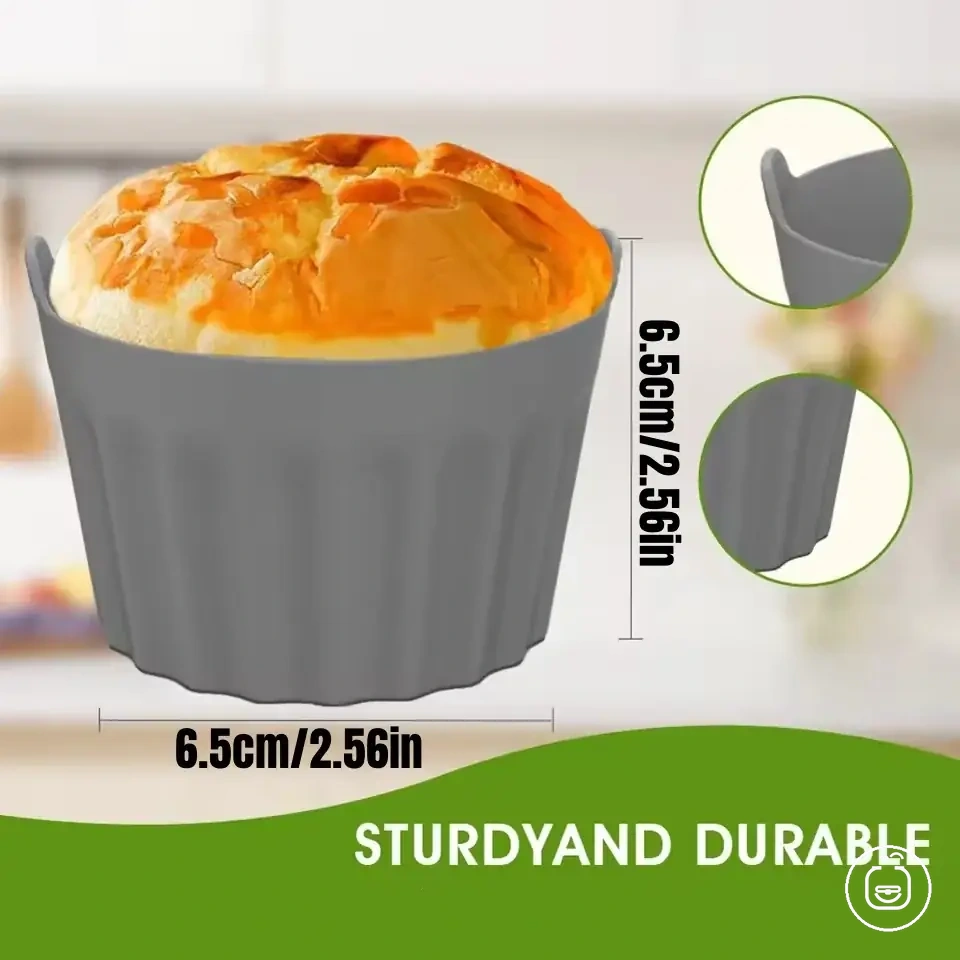
Product examples are only illustrative references after the criteria evaluation and should not define the decision itself, but help understand how different kits or separate accessories align with real usage conditions.
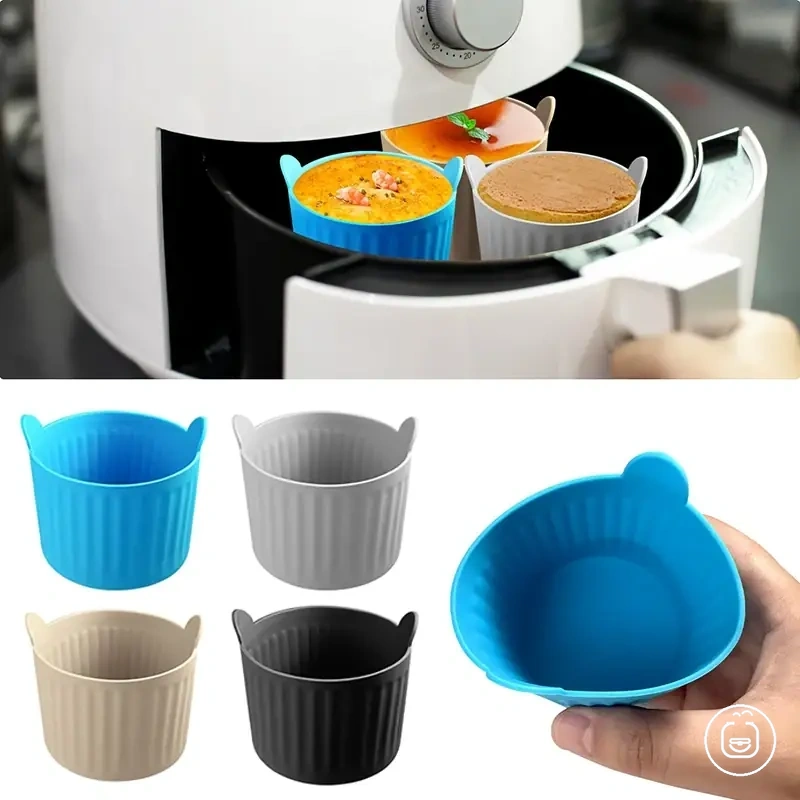
The products below are useful examples for comparing available options. Before buying, check that the compatibility criteria, key features, and product details match your needs.
This chart shows the key checks and decision options for choosing between a kit and separate air fryer accessories.
Value verdict for sets versus individual accessories
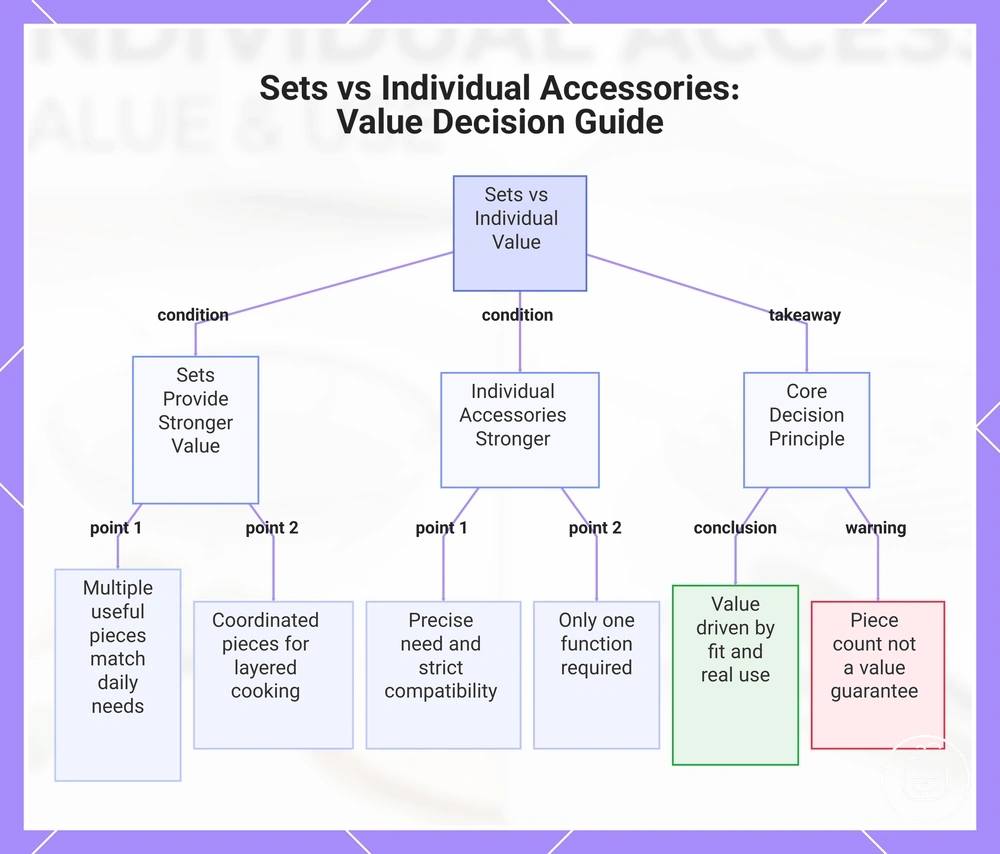
The value verdict for sets versus individual accessories depends on fit, real use, and how many pieces are actually used rather than total piece count. Accessory sets tend to provide stronger value when multiple useful pieces match everyday cooking needs, while individual accessories often deliver stronger value when precise need and strict compatibility requirements dominate. The strongest value comes from aligning the choice with real use conditions.
Recommendation summary:
- Beginners — accessory sets may provide stronger value when multiple basic tools are needed together for general cooking coverage.
- Frequent bakers — accessory sets can be more useful when baking tools are repeatedly used in combined cooking setups.
- Cleanup-focused users — individual accessories may provide better value when only specific cleaning-related tools are needed.
- Rack-and-pan users — sets may offer stronger value when layered cooking requires multiple coordinated pieces.
- Strict compatibility users — individual accessories often provide better value when exact fit and limited space restrict set usability.
The real decision is not about sets or individual accessories being universally better, but about how closely the option matches actual cooking needs. Higher piece count does not guarantee higher usable value if items remain unused, while separate accessories can reduce waste when only one function is required. Value improves when selection is driven by fit and real use rather than bundle size, with illustrative products considered only after this evaluation.
The products below are useful examples for comparing available options. Before buying, check that the compatibility criteria, key features, and product details match your needs.
This chart shows the conditions under which accessory sets or individual accessories provide stronger value, based on fit, real use, and matching cooking needs.